
Pyle PDC21
4.5Editor score
Passive transformer design
Hum elimination switch
Durable steel chassis
A bass direct box is essential for converting high impedance instrument signals to low impedance balanced signals. This ensures clean transmission to mixers without noise or signal loss during performances.
We evaluated ten top models based on build quality, transformer performance, and ease of use. Our selection includes passive and active units suitable for various budgets and professional requirements.
Each pick highlights key features and ideal use cases for different musicians. Prices vary by retailer and change frequently, so always verify current availability before making your final purchase decision.
4.5Editor score

4.8Editor score
4.8Editor score
As an Amazon Associate we earn from qualifying purchases.
This table provides a quick side-by-side comparison of all ten selected models. Use it to identify the key specifications and features that matter most for your specific audio routing needs.




This Pyle direct box is an entry-level option for musicians needing basic signal conversion. It carries a solid rating and focuses on simplicity for connecting unbalanced instruments to balanced systems.
We may earn a commission when you buy through this link, at no additional cost to you.
Its passive design allows for straightforward connection without external power. The transformer helps balance the signal while the ground lift adapter reduces noise issues common in live environments.
Users note that while functional, the build quality is less robust than professional units. It may not withstand heavy touring but works well for practice sessions or casual home recording.
This model is ideal for beginners who need an affordable DI solution quickly. It offers a clear path for testing signal routing before investing in higher-end equipment.
The core function transforms high impedance instrument signals to low impedance mic level for mixer compatibility.
A dedicated ground lift adapter helps eliminate hum caused by ground loops in audio systems.
We may earn a commission when you buy through this link, at no additional cost to you.
The Pyle PDC21 improves on basic passive designs with a sturdy steel chassis. It maintains a good rating by offering more durable construction at a budget-friendly price point for hobbyists.
We may earn a commission when you buy through this link, at no additional cost to you.
This model includes an input attenuator which helps manage signal levels from active sources. The hum eliminator function ensures cleaner audio when connecting to mixers in noisy electrical environments.
While heavier than some plastic alternatives, the steel build adds to its longevity. However, users may find the frequency response slightly less detailed compared to professional grade passive units.
It is a great choice for budget-conscious users needing reliability. The attenuator adds versatility that makes it useful for connecting various signal sources beyond standard passive instruments.
All steel chassis design ensures the unit can withstand bumps and drops during transport or storage.
The input attenuator allows you to reduce signal levels to prevent clipping in downstream equipment.
We may earn a commission when you buy through this link, at no additional cost to you.
The Radial Pro DI sets a benchmark for passive units with its I-beam construction. It is highly rated for its ruggedness and ability to maintain sound quality under tough touring conditions.
We may earn a commission when you buy through this link, at no additional cost to you.
It utilizes a custom transformer that provides a transparent signal path. This design choice minimizes coloration and ensures the natural tone of your instrument reaches the mixing console accurately.
The build quality is exceptional, often cited as indestructible by road crews. However, the single channel design limits its use if you need to connect two instruments simultaneously.
Investors in professional setups often choose this model for its dependability. It is a workhorse unit that justifies its cost through years of consistent performance and reliability.
A custom engineered transformer ensures high fidelity audio transfer with minimal signal degradation.
The I-beam chassis offers superior structural strength for protection during travel.
We may earn a commission when you buy through this link, at no additional cost to you.
The Whirlwind IMP 2 is an award-winning unit that balances cost and performance. It earns the Editor's Choice badge for delivering professional sound quality in a simple economical package.
We may earn a commission when you buy through this link, at no additional cost to you.
Its riveted transformer construction ensures a solid connection between internal components. This method prevents loosening over time and contributes to the unit's high reliability rating in live settings.
While it lacks a dedicated ground lift switch, the transformer isolation often handles noise issues effectively. The compact size makes it easy to fit into crowded pedalboards or flight cases.
This box is perfect for those needing a no-fuss reliable tool. It offers the core functionality required for clean signal routing without unnecessary features that add cost.
The TRHL transformer used in this model provides a rich and natural tone transfer.
A small footprint allows it to fit easily into tight gear racks or pedalboards.
We may earn a commission when you buy through this link, at no additional cost to you.
The Pyle PDC22 offers two channels in a passive form factor. It maintains a decent rating for budget users who need to connect multiple instruments without adding bulk or power requirements.
We may earn a commission when you buy through this link, at no additional cost to you.
This model includes an input attenuator for managing signal levels from active sources. The hum eliminator helps ensure clean audio transmission when running cables through noisy electrical environments.
Users note that while functional, the build quality can vary between units. It serves well for practice or low-volume gigs but may lack the refinement of premium professional passive units.
It is a practical choice for multi-instrumentalists on a budget. The ability to handle two signals simultaneously makes it versatile for small setups needing basic signal management.
Two independent channels allow you to connect and switch between different instruments easily.
Attenuators help prevent signal clipping when connecting active instruments or line level sources.
We may earn a commission when you buy through this link, at no additional cost to you.
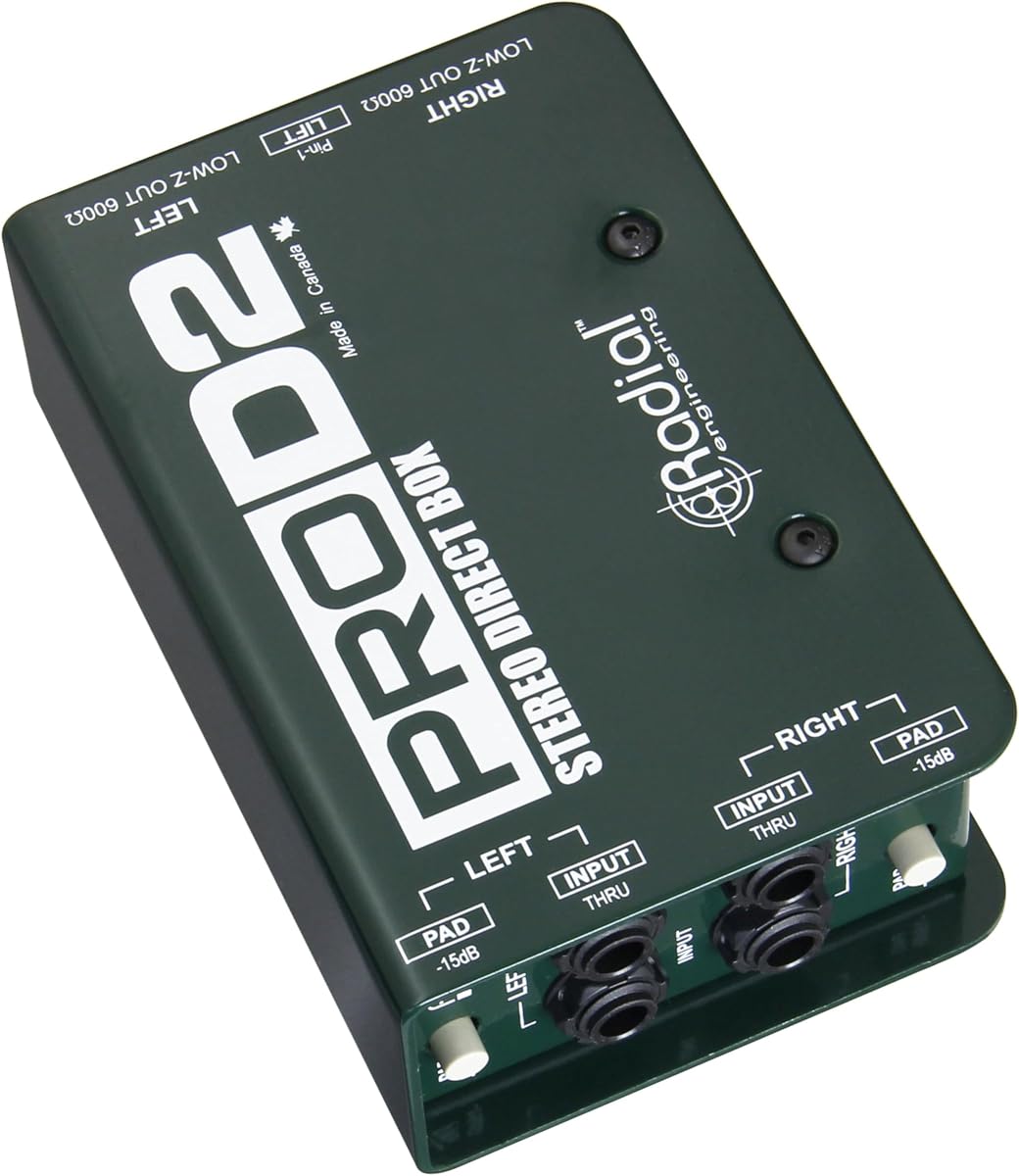
The Radial ProD2 delivers high-end performance with two channels of passive conversion. It holds a premium rating and features dual isolation transformers for independent stereo signal handling.
We may earn a commission when you buy through this link, at no additional cost to you.
Its ground lift switches allow you to break ground loops on either channel independently. This flexibility ensures that each input can be optimized for clean noise-free audio in complex setups.
The inclusion of a 15dB pad provides extra dynamic range for high output instruments. This feature is crucial for preventing distortion when connecting active basses or keyboards.
This box is ideal for professionals needing dual channel reliability. It handles stereo keyboards and multi-instrument rigs with ease while maintaining the sound quality you expect from Radial.
Dual independent channels maintain true stereo separation for keyboards and synth outputs.
A 15dB pad ensures clean signal conversion for high output active instruments.
We may earn a commission when you buy through this link, at no additional cost to you.
The Bolanle DB2 offers a modern take on the classic passive design. It is highly rated for providing essential features like ground lift and signal attenuation at an affordable price point.
We may earn a commission when you buy through this link, at no additional cost to you.
This unit includes three attenuation settings to control signal levels effectively. The ground lift switch helps eliminate hum ensuring that your recordings remain clean and professional sounding.
The chassis is built to resist scratches and damage during transport. While newer to the market it has earned a reputation for offering strong value without sacrificing core performance needs.
It is a practical option for home studios needing flexibility. The dual channels and attenuation options make it versatile for various instruments beyond just bass or guitar.
Three attenuation settings allow precise level control for various instrument types and outputs.
The chassis design is scratch-resistant and built to withstand regular transport and use.
We may earn a commission when you buy through this link, at no additional cost to you.
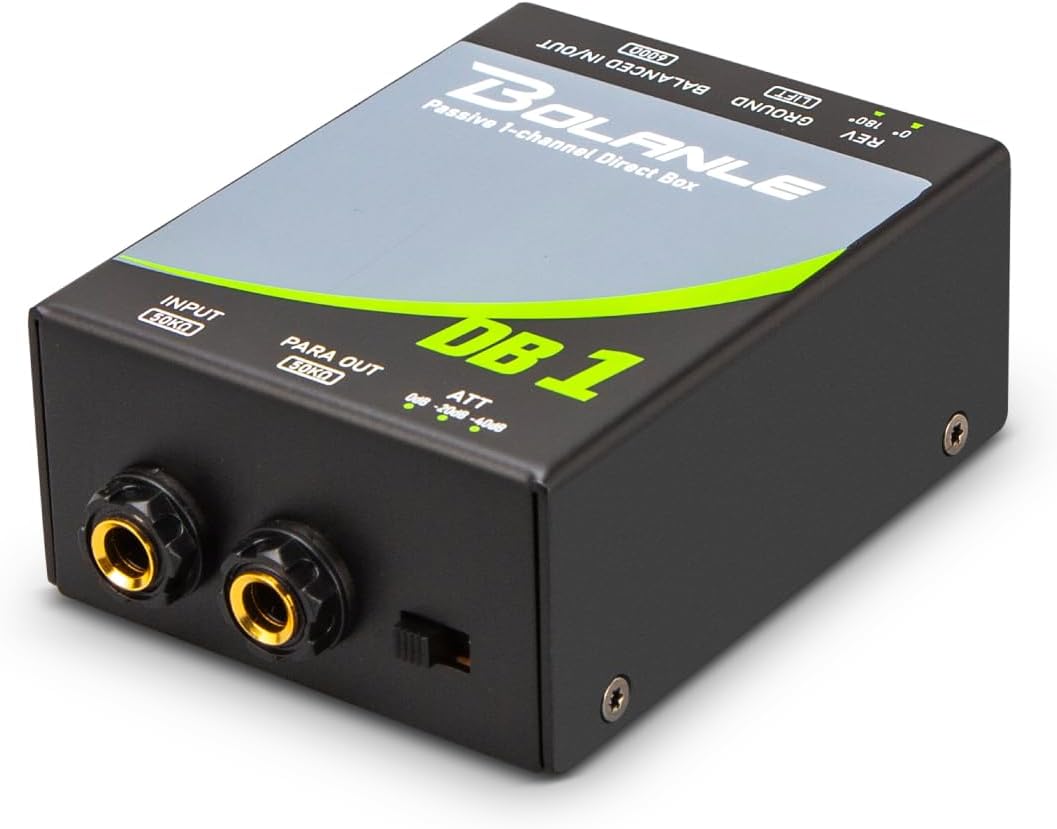
The Bolanle DB1 focuses on simplicity with a solid passive design. It holds a strong rating for offering a reliable signal conversion tool that requires no external power supply.
We may earn a commission when you buy through this link, at no additional cost to you.
A key feature is the parallel output which allows you to send signal to an amp and PA simultaneously. This makes it easy to blend monitor sounds with the main mix during live performance.
Its attenuation switch helps manage hot signals preventing unwanted distortion or clipping. The road-ready design ensures it can survive the rigors of touring and regular studio use.
This box is a smart pick for guitarists needing flexibility. The loop output is particularly useful for running pedalboards alongside direct inputs without complex cabling.
A loop output allows you to connect to amps and mixers simultaneously without signal loss.
As a passive unit it requires no batteries or phantom power to function correctly.
We may earn a commission when you buy through this link, at no additional cost to you.
The Bolanle J22 brings active stereo capability with flexible power options. It is rated well for allowing users to run on phantom power a battery or USB depending on the venue.
We may earn a commission when you buy through this link, at no additional cost to you.
Its dual channels maintain full stereo separation for instruments like keyboards. The ground lift switch helps eliminate interference ensuring noise-free transmission even on loud stages.
The metal housing adds durability for touring use. While active units can be more complex the dual power options here provide a safety net against power failures during shows.
This model suits keyboard players and synth users needing stereo precision. The ability to use USB power makes it ideal for mobile setups lacking traditional phantom power sources.
Three power modes including USB and phantom ensure you can run the unit anywhere.
Dual channels preserve left right separation for accurate stereo sound reproduction.
We may earn a commission when you buy through this link, at no additional cost to you.
The Radial Pro48 provides high-resolution active conversion for demanding applications. It maintains a high rating for delivering transparent audio quality with professional features in a compact package.
We may earn a commission when you buy through this link, at no additional cost to you.
It includes a -15dB pad to handle high level inputs from active basses. This feature prevents distortion and ensures the signal path remains clean and dynamic throughout the recording.
Its compact size makes it easy to integrate into complex rack setups. The active circuitry allows for better handling of low output passive pickups without signal loss over long cables.
This box is ideal for professionals needing active precision. It combines the convenience of phantom power with the reliability expected from a trusted manufacturer in the industry.
Active components ensure high resolution audio transfer with minimal noise floor.
A -15dB pad provides control over high output active instrument signals.
We may earn a commission when you buy through this link, at no additional cost to you.
Selecting the right bass direct box requires understanding your specific needs regarding signal type and budget. Use this guide to identify the key factors that impact performance and durability.
Passive units rely on transformers to convert signals and require no power. Active units use internal circuitry often powered by phantom power or batteries to provide higher signal quality.
Choose passive for simplicity and active for low output signals or high fidelity requirements.
A single channel box is sufficient for solo bassists. However multi-instrumentalists may need two channels to connect keyboards and other sources simultaneously.
Select a model with multiple channels if you need to route stereo or dual instrument signals.
The transformer is the heart of a passive DI. High-quality transformers ensure a flat frequency response and minimal coloration of your instrument tone.
Prioritize units with custom or premium transformers to ensure professional sound quality.
Touring musicians need a chassis that can withstand bumps and drops. Steel or reinforced chassis designs offer better protection than plastic enclosures.
Look for metal housings if you plan to transport your gear frequently to gigs.
Ground loops cause hum in audio systems. A ground lift switch breaks the connection at the ground path to eliminate this noise.
Ensure your chosen box has a ground lift feature to avoid noise issues.
Active instruments often output hot signals that can clip. An attenuator pad reduces signal levels to keep the audio clean.
Check for a -15dB or similar pad if using active basses or keyboards.
Standard 1/4 inch inputs and XLR outputs are essential. Some units offer parallel outputs for monitoring while others have stereo connections.
Verify the input and output jacks match your existing gear setup.
Prices range from affordable to premium. Determine your budget but remember that higher cost often correlates with better components.
Balance the cost against the features needed for your specific recording or live situations.
Start by connecting your instrument to the 1/4 inch input. Use a balanced XLR cable to connect the output to your mixer interface channel for clean signal transmission.
If you hear a hum engage the ground lift switch to break ground loops. If signals distort try engaging the attenuator pad to reduce input levels.
Store your box in a dry place to prevent corrosion. Handle it gently and avoid dropping it to protect internal components from damage over time.
Yes it is essential for converting your instrument signal to a balanced mic level. This reduces noise and allows you to connect your bass to audio interfaces and mixers effectively.
Passive boxes use transformers and no power while active boxes use electronics requiring power. Active units generally offer better handling for low output instruments like passive pickups.
Yes most direct boxes are universal and work with both bass and guitar. They simply convert the high impedance signal to low impedance for mixers.
Use a parallel output if available to send one signal to the amp and another to the mixer. If no parallel out exists a splitter cable may be needed.
Hum is often caused by ground loops. Engage the ground lift switch to eliminate it. Also ensure your power sources and gear are properly grounded.
Active boxes typically run on 48V phantom power from mixers. Some models also use batteries or USB power for flexibility in different environments.
Solo musicians only need one channel. However if you play keyboards or multiple instruments simultaneously you should choose a two channel model.
High quality units like Radial or Whirlwind are built to withstand touring. Look for steel chassis and rugged construction to ensure longevity.
We have reviewed ten top models ranging from budget options to professional units. Each pick offers distinct features to suit different needs and setups.
Consider your primary use case before deciding. Active models offer precision while passive ones provide simplicity and reliability without power dependency.
Always check current prices and availability as they can change quickly. Selecting the right box ensures your sound remains clear and professional every time.