
D-FantiX Battery Tester
4.5Editor score
No battery required to operate
Compact and practical size
Color-coded analog display
This guide compares the top battery tester for household batteries to help you choose the right model for checking AA AAA C D and 9V power levels accurately.
Finding a reliable battery tester for household batteries is essential for managing your electronics efficiently. Whether you use remotes toys or flashlights knowing when power is low prevents unexpected downtime and keeps your devices running smoothly.
We analyzed the leading models based on compatibility accuracy and ease of use. Our list covers digital and analog options ranging from pocket-sized tools to universal checkers that support a wide array of battery types and chemistries.
Each pick highlights specific strengths and limitations to help you decide. Prices and availability can change over time so always verify the latest details before purchasing to ensure you get the best value for your needs.
4.5Editor score

4.5Editor score

4.6Editor score
This table provides a side-by-side comparison of all ten models highlighting their key specifications and unique features to help you make an informed decision based on your specific testing requirements.

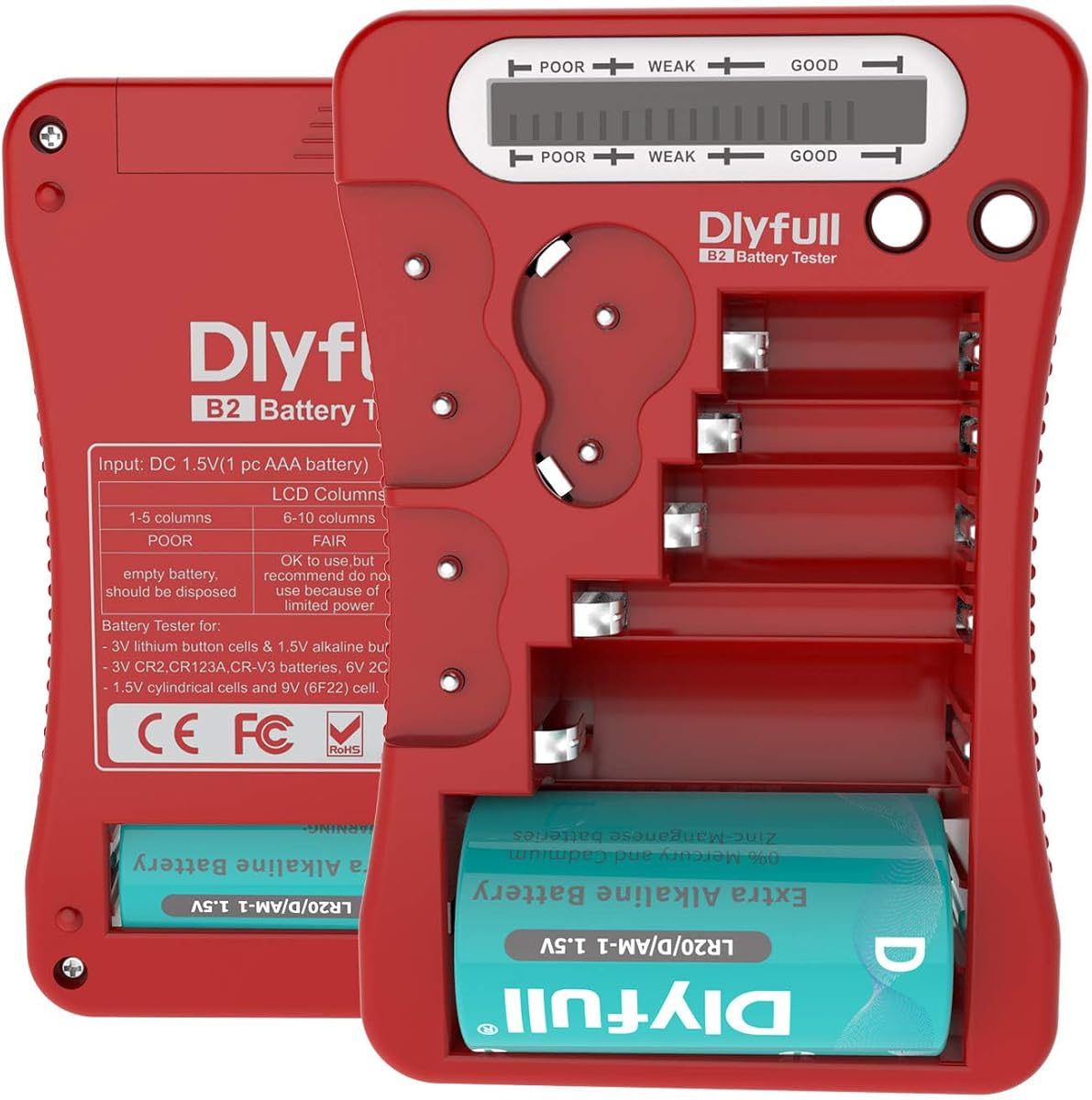


This Dlyfull Battery Tester offers exceptional versatility for household needs. With a rating of 4.5 stars it is a top pick for its wide range of compatible battery types. The crisp LCD screen makes it easy to see exactly where your batteries stand.
We may earn a commission when you buy through this link, at no additional cost to you.
Its standout feature is the high compatibility covering AA AAA C D 9V and many button cells. The quick results feature uses clear bar indicators to show health status helping you avoid unnecessary recharges or premature disposal of working batteries.
The main trade-off is that it does not support rechargeable batteries. While this limits scope for some users it simplifies the device for standard alkaline testing. The compact anti-slip chassis ensures a firm grip during use.
If you want a reliable tool that handles most household sizes with ease this is an excellent choice. It saves money by helping you identify good batteries quickly and is small enough to keep in a drawer.
Supports cylindrical and button cell types for broad utility.
Crisp LCD with bar indicators simplifies status reading.
We may earn a commission when you buy through this link, at no additional cost to you.
This Universal Battery Checker distinguishes itself with real-load testing capabilities. It provides precise voltage readings and power level indicators to eliminate guesswork. The clear LCD display shows exact battery health status for accurate decision making.
We may earn a commission when you buy through this link, at no additional cost to you.
A key strength is its ability to test 1.2V rechargeable AA AAA and AAAA batteries. The smart detection system prevents incorrect testing ensuring you get valid results. The auto power-on feature activates when battery voltage exceeds 0.7V.
Users should note that it requires a separate AAA battery for operation which is not included. Also the screen lacks a backlight which might make it harder to read in dim lighting conditions.
For those who need to test rechargeables and want detailed voltage data this model is a strong option. It balances precision with portability making it suitable for both home and workshop environments.
Uses discharge resistors to simulate actual battery load.
Uniquely tests 1.2V rechargeable battery types.
We may earn a commission when you buy through this link, at no additional cost to you.
The Dlyfull Digital Checker is designed for simplicity and portability. With a high rating of 4.6 stars it delivers fast and accurate results for a wide variety of household batteries. The easy to use analyzer shows exactly what you need to know.
We may earn a commission when you buy through this link, at no additional cost to you.
Its compact design makes it one of the smallest options available. You can easily carry it in a pocket or store it in a small drawer. The anti-slip finish ensures a firm grip when checking battery health quickly.
Like other models in this category it does not support rechargeable batteries. This keeps the device simple and focused on standard voltages. It does include an AAA battery so you can start testing right away.
This is ideal for users who prioritize size and ease of use over advanced features. It helps you avoid wasting money on unnecessary purchases by clearly identifying good and bad batteries in seconds.
One of the smallest and lightest battery checkers available.
Simple one-step placement for instant status bars.
We may earn a commission when you buy through this link, at no additional cost to you.
This D-FantiX Battery Tester is a practical solution for basic testing needs. It requires no battery to operate because it uses the power of the battery being checked to move the analog display needle. The color-coded scale makes status clear.
We may earn a commission when you buy through this link, at no additional cost to you.
The analog display needle moves on a calibrated scale to identify good low and replace recharge status. It works with standard and rechargeable household batteries including AA AAA C D 9V and button types. It is simple but effective for home use.
While it does not provide exact voltage numbers the visual cue is often enough for most users. The main limitation is that it is less precise than digital models so it may not detect borderline cases as accurately.
For those on a tight budget this is an excellent entry level option. It saves time and money by preventing waste and is easy to store anywhere in the house due to its small size.
Operates entirely from the battery under test.
Color-coded analog scale for quick status checks.
We may earn a commission when you buy through this link, at no additional cost to you.
The La Crosse 911-65557-INT offers a premium testing experience with digital precision. It tests both rechargeable and alkaline batteries providing reliable results. The LED display shows voltage and strength levels clearly after you close the tray.
We may earn a commission when you buy through this link, at no additional cost to you.
Its simple operation involves three easy steps. You select the voltage range pull the tray insert the battery and slide it closed. This ensures a positive connection and accurate reading every time. It covers AAA AA C D N and 9V types.
Users may find the tray sliding action slightly less convenient than direct slot testers. However the benefit is secure contact and accurate results. It is a robust choice for those who rely on rechargeable AA or AAA batteries.
If you value accuracy and need to manage multiple battery types this unit stands out. It is a trusted brand known for quality and the digital display gives you confidence in your results.
Select 1.5V 1.2V or 3.0V based on battery type.
Tray mechanism ensures consistent positive contact.
We may earn a commission when you buy through this link, at no additional cost to you.
This 2 Pack Battery Checker offers excellent value for households with multiple testing spots. Each unit provides accurate readings of voltage levels for almost all types of batteries. You simply place the battery in the correct slot and read the indicator bars.
We may earn a commission when you buy through this link, at no additional cost to you.
The design is compact and light enough to fit easily into your pocket. Since it requires no battery for operation you do not need to worry about replacements. It helps avoid the hassle of guessing which batteries are good.
While the digital interface is basic it gets the job done for most needs. It is a great option for keeping one in the garage and one in the kitchen for quick checks on household items.
For those who want a simple affordable solution that lasts this set is a smart buy. It ensures you always have a tester on hand without spending much money on a single unit.
Get two testers for versatile placement around the home.
Self-powered design means no internal battery to replace.
We may earn a commission when you buy through this link, at no additional cost to you.
The Tenergy T-333 is an inexpensive unit to add to your household electronics must-haves. It works with 12 different battery types including common sizes and specialty ones. The LCD display shows you the status and health of your inserted battery.
We may earn a commission when you buy through this link, at no additional cost to you.
This tester is powered by one AAA battery which is included in the package. It is a low power product that will come in very handy for all your electronics powering needs. The compact design makes it easy to store.
One note is that the LCD contrast may not be as sharp as high-end models. Also it requires a separate battery to operate which might be a minor inconvenience compared to self-powered units.
For those needing a reliable all-in-one checker at a low cost this is a strong pick. It helps you quickly decide if your device is broken or if the battery is out of power.
Handles 12 sizes from AA to CR123A and button cells.
Comes with AAA battery so you can use immediately.
We may earn a commission when you buy through this link, at no additional cost to you.
This Gardner Bender tester is a classic analog solution with test leads for easy testing. It covers a 14 battery range including standard household and lantern cells. The analog display makes it clear if they are charged or need replacement.
We may earn a commission when you buy through this link, at no additional cost to you.
The inclusion of test leads makes it versatile for batteries that cannot fit into a slot. You can use the leads to connect to exposed terminals on larger or specialty batteries. This adds flexibility that slot-only testers lack.
The downside is that it is larger and bulkier than the compact digital models. It also requires manual connection of leads which takes slightly longer than dropping a battery into a slot.
For those who need to test a broader range of battery types including lanterns this is a solid choice. It is a durable tool that is well suited for a toolbox or workshop environment.
Test leads allow connection to various terminal types.
14 battery range covers most household and lantern cells.
We may earn a commission when you buy through this link, at no additional cost to you.
The Dlypow Magnetic Tester features a built-in magnetic tip that grabs and holds the battery in the ideal position. This secure contact provides a stable signal for a highly accurate measurement shown clearly on the classic analog display.
We may earn a commission when you buy through this link, at no additional cost to you.
The magnetic design ensures the battery stays in place while you read the results. It is designed for everyone with a simple one-step process that delivers results in seconds. The large clear display ensures battery status is immediately obvious.
You will need to ensure your batteries are compatible with the magnetic tip. Some batteries may not have a strong enough case to hold securely. Also it is limited to magnetic testing rather than direct slot insertion.
For those who appreciate innovative design that improves accuracy this is a great option. It helps you sort the dead from the good quickly and is lightweight enough to take anywhere.
Magnetic tip ensures stable signal for accurate reading.
Analog display is clear and simple to read.
We may earn a commission when you buy through this link, at no additional cost to you.
This Universal Household Checker features a sophisticated LCD display screen that showcases the voltage and battery level of the tested battery. The battery level is presented in two formats as a percentage and battery level bar display for clear precise information.
We may earn a commission when you buy through this link, at no additional cost to you.
It is compatible with 12 battery types including various chemistries and sizes. You can test cylindrical batteries using the pin or place button cells in their slots. It also has a check button for self-test to ensure accuracy.
The unit requires 1.5V AAA alkaline batteries to power the tester which must be purchased separately. While it is compact and lightweight it is more complex to set up than simpler analog tools.
If you want detailed percentage data for your battery health this is a strong choice. It is useful for those who need to track remaining capacity more precisely than basic bar indicators allow.
Shows battery level as a percentage for detail.
Works with 12 types including various chemistries.
We may earn a commission when you buy through this link, at no additional cost to you.
Choosing the right tester depends on your specific needs. This guide covers key factors to consider to ensure you get accurate results without overspending.
The most important factor is whether the device supports the batteries you use most. Check for support for AA AAA C D and 9V as these are the most common household sizes. If you use button cells or rechargeables ensure the model explicitly lists them in its specs.
Look for a tester that covers your main battery types to avoid buying multiple devices.
Digital testers provide exact voltage readings which are helpful for precision. Analog testers use a needle and scale which can be easier to read at a glance. Consider whether you need a percentage bar or a simple good low status.
Digital is more precise while analog is often simpler and cheaper for basic needs.
Some testers require an internal battery like AAA to operate while others are self-powered. Self-powered units save on future battery costs but may be slightly less precise. If you prefer convenience check if the device includes its power battery.
Self-powered units are cost-effective over time while internal batteries offer consistency.
Advanced testers use real-load testing to simulate actual battery use. This gives you a truer picture of battery health than voltage alone. If you want to know if a battery will work under load this feature is valuable.
Real-load testing helps avoid false positives from batteries that read well but fail in use.
A compact design makes it easier to store the tester in a drawer or tool box. Look for lightweight units that you can carry around your home. Some models even have anti-slip finishes for a better grip during testing.
Portability ensures you can check batteries quickly wherever you need them.
A sturdy construction ensures the tester lasts longer with daily use. Look for robust test slots and spring-loaded contacts that protect the battery during testing. High-quality materials prevent damage from drops or rough handling.
Choose a durable model to avoid replacing it frequently due to wear.
Simple operation helps you test batteries quickly without confusion. Features like auto power-on and one-step slots make the process easier. Check for clear displays that are easy to read even in low light.
Ease of use encourages regular checks and ensures you get accurate results quickly.
A good warranty shows the manufacturer stands behind their product. Look for offerings like one year or more to cover defects. Friendly customer service can help if you have questions about testing or device issues.
Check for warranty details to ensure peace of mind with your purchase.
To get accurate results insert the battery into the correct slot. Ensure the terminals match the tester indicators to avoid incorrect readings.
Wait for the display to stabilize before reading the status. For digital units this may take a second or two for the exact voltage to appear.
Store the tester in a dry place to prevent corrosion. If it uses internal batteries remove them when not in use to extend the device life.
Most household testers cover AA AAA C D and 9V. Some specialty types may not fit or read correctly. Always check the compatibility list before testing unknown battery types.
Only some models support rechargeables. Check if the device lists 1.2V support for accurate readings. Standard testers may give incorrect results for these types.
Internal batteries power digital displays and load testers. Self-powered analog units rely on the test battery for power. Check the manual for specific power requirements.
Accuracy varies by model. Digital units with load testing are generally more accurate. Basic analog testers provide a good estimate but may not show exact voltages.
Real-load testing simulates how the battery performs under use. It gives a truer picture of health than just measuring voltage. Look for this feature in advanced models.
Keep the slots clean and free of debris. Remove internal batteries when not in use to prevent corrosion. Store the device in a cool dry place.
Most modern testers have specific slots for button cells. Check for CR1616 CR2032 and other common sizes on the device. Proper alignment ensures accurate results.
Digital offers more precise data while analog is simpler and cheaper. Consider your need for details versus ease of use. Both can help you manage battery health effectively.
Our top picks include the Dlyfull Universal Tester for versatility the D-FantiX for value and the La Crosse for rechargeable precision. Each offers unique strengths for different household needs.
Prioritize compatibility and ease of use when selecting a model. Ensure it supports your most common battery types and is simple to operate for daily checks.
Remember to check current availability and details before purchasing. Prices may vary so verify the latest offer to get the best value for your needs.