
WOSPORTS Mini Trail Camera
4.2Editor score
Low power 4 AA battery design
Compact lightweight camouflage body
Fast trigger motion detection
Discover the top battery life trail camera options for outdoor monitoring. We compare power efficiency, solar options, and runtime across ten leading models
Finding a trail camera with exceptional battery life is crucial for remote monitoring. Long-lasting power ensures you never miss critical wildlife moments or security events during extended deployment periods in the field.
We evaluated ten top-rated models based on power consumption, solar compatibility, and real-world runtime data. Our analysis covers non-cellular and cellular options to help you choose the most efficient device for your needs.
Each pick highlights unique power features and operational strengths. Note that prices fluctuate frequently so verify current costs before purchasing. These selections represent the best balance of performance and energy efficiency available today.
4.2Editor score

4.3Editor score

4.2Editor score
This side-by-side comparison evaluates ten leading trail cameras focusing on their power systems and operational endurance. Review these specifications to determine which model offers the longest runtime for your specific outdoor monitoring requirements.




The WOSPORTS Trail Camera stands out for its versatile power management system. With a 4.3 rating it offers users the ability to switch between standard alkaline batteries and renewable energy sources like solar panels. This flexibility ensures continuous operation even during extended deployments in remote locations where battery swaps are inconvenient. Its robust design and high-resolution output make it a top choice for serious wildlife monitors and security enthusiasts who prioritize uptime over convenience.
We may earn a commission when you buy through this link, at no additional cost to you.
At the core of this model is its dual power capability. It supports eight AA batteries for standard operation but also allows integration with rechargeable lithium batteries or compatible solar panels sold separately. This design choice significantly reduces maintenance trips to the field. The camera features a 0.2-second trigger speed ensuring that fast-moving wildlife is captured without blur. Additionally the 4K video resolution provides crisp details for analyzing animal behavior or property security incidents.
While highly efficient the camera does require initial investment in external power accessories to maximize runtime. Alkaline batteries are not included so users should budget for quality lithium alternatives for better performance. The lack of cellular connectivity means you must physically retrieve the SD card to review footage which limits real-time monitoring capabilities. However for those focused on pure battery life and image quality this trade-off is often acceptable for seasonal scouting.
This camera is ideal for hunters and landowners who need reliable long-term monitoring without constant maintenance. Its ability to adapt power sources makes it superior for areas with varying sunlight exposure. We recommend pairing it with a high-capacity solar panel for maximum endurance. If you value high-resolution imaging and flexible power management over instant remote alerts the WOSPORTS Trail Camera delivers exceptional value and performance.
Supporting both AA batteries and solar panels allows users to tailor power solutions to their specific terrain and deployment duration needs.
The 64MP photo and 4K video capabilities ensure that every captured moment is detailed enough for identification and analysis.
We may earn a commission when you buy through this link, at no additional cost to you.
The Moultrie Edge 3 Cellular brings smart technology to battery management with its 4.3 rating. It features rechargeable lithium battery packs and solar panel compatibility which drastically reduce the need for manual battery changes. Users can monitor battery levels remotely through the app ensuring you are never caught off guard by a dead unit. This connectivity makes it a strong contender for those who want efficiency without sacrificing real-time data access in the field.
We may earn a commission when you buy through this link, at no additional cost to you.
Efficiency is enhanced by its ability to connect to the strongest of four major US networks without SIM cards. The AI buck detection feature reduces false alerts which saves battery power by not triggering recordings for irrelevant movement. You can adjust settings and check feed levels directly from the app allowing you to optimize camera performance without physically visiting the site. The built-in GPS ensures you always know the exact location of your cameras.
A key consideration is the monthly subscription fee starting at $9.99. While this adds to the cost it provides the convenience of cellular data transmission and remote management. The rechargeable power options are a significant upgrade over standard disposable batteries but require upfront investment in specific packs. If you prefer constant connectivity and data efficiency over pure low cost this model offers a balanced approach to modern trail camera usage.
This camera is best suited for active hunters and property managers who value real-time information. The combination of remote battery monitoring and solar readiness ensures high uptime. For users willing to pay for a subscription service the Edge 3 provides superior convenience and power efficiency. It is a top choice for those who want to stay connected to their wildlife activity from anywhere.
Check battery life directly from the app to plan maintenance trips efficiently and avoid missing critical data windows.
AI buck detection reduces unnecessary recordings which helps conserve battery life by focusing only on significant targets.
We may earn a commission when you buy through this link, at no additional cost to you.
The MAXDONE Solar Trail Camera is designed for truly unlimited power with a 4.2 rating. It features a built-in 6000mAh rechargeable battery paired with high-efficiency solar charging. This combination allows for continuous operation without replacing disposable batteries ever. For users seeking a maintenance-free experience this solar integration is a game changer. It ensures your camera remains active year-round regardless of seasonal battery drains.
We may earn a commission when you buy through this link, at no additional cost to you.
Beyond power the camera offers WiFi and Bluetooth APP control via a free app. This means you can view and download photos without removing the SD card. The built-in hotspot connects up to 55 feet allowing convenient on-site setup. High resolution 64MP photos and 4K videos ensure you capture every detail. The IP66 waterproof rating guarantees durability in rain or snow making it suitable for harsh outdoor environments.
One limitation is that it only supports its own built-in hotspot and does not connect to home WiFi or cellular networks. The hotspot range is also limited to 55 feet which may restrict where you can stand during setup. While this restricts remote access it keeps data local and secure. For those who prioritize solar energy and on-site control over remote connectivity this model delivers exceptional value.
This camera is perfect for homeowners and hunters who want set-and-forget power. The solar charging capability eliminates the hassle of buying batteries every few months. If you have a sunny spot for your camera this model will likely run indefinitely. We recommend it for users who value long-term sustainability and high image quality without the cost of cellular plans.
The integrated solar panel keeps the battery charged continuously providing months of maintenance-free operation in sunny conditions.
Storing data locally on the SD card protects privacy and avoids subscription fees associated with cloud storage services.
We may earn a commission when you buy through this link, at no additional cost to you.
The Meidase P70 earns a 4.4 rating for its robust battery-ready design. It supports the Meidase SP350 Solar Panel sold separately for unlimited power. This allows you to pair solar energy with 8 AA batteries as a backup ensuring maximum reliability. The camera captures crystal-clear 64MP photos and 1296p videos day and night. Its fast 0.1s trigger speed ensures you never miss quick wildlife movements.
We may earn a commission when you buy through this link, at no additional cost to you.
Power efficiency is improved by H.264 technology which compresses videos for faster downloads and lower storage usage. The no-glow night vision uses 940nm LEDs to avoid spooking animals. You can review footage on the spot with the 2.4 color display and intuitive controls. This makes field adjustments easier without needing to remove the SD card. The durable waterproof design handles rain and dust effectively.
A downside is that the solar panel must be purchased separately adding to the initial cost. Since it lacks cellular and WiFi connectivity you must visit the site to retrieve data. However this simplicity reduces power consumption significantly. The backup battery option ensures it keeps working even if sunlight is temporarily unavailable. This hybrid approach is excellent for deep woods deployments.
This model is ideal for users who want to upgrade to solar easily. Its compact design and fast performance make it a versatile tool for hunting or security. If you are looking for a reliable camera that can transition to solar power efficiently the P70 is a strong candidate. It balances image quality and power flexibility well.
Combining solar power with AA battery backup ensures the camera stays online even during extended cloudy periods.
The 0.1s trigger speed guarantees that fast-moving animals like deer or coyotes are captured clearly without blur.
We may earn a commission when you buy through this link, at no additional cost to you.
The WOSPORTS Mini Trail Camera offers a budget-friendly option with a 4.2 rating. It runs on only 4 AA batteries making it lighter and easier on power than models requiring 8 batteries. The compact low-power design supports longer standby times for extended outdoor use. Its 30MP photos and 1080P HD videos provide clear detail for wildlife monitoring. This makes it an excellent choice for beginners or those monitoring multiple locations.
We may earn a commission when you buy through this link, at no additional cost to you.
The mini design weighs only 0.73lbs and measures just over 4 inches in each dimension. This small size helps it blend into foliage easily avoiding detection. The 850nm infrared LEDs provide clear night vision while minimizing disturbance to wildlife. Setup is simple with an adjustable mounting strap included. You can mount it on trees or posts quickly without complex tools.
Limitations include lower video resolution compared to premium models and a lack of solar support. The camera relies solely on alkaline or lithium AA batteries for power. While this keeps costs down it means periodic battery swaps are necessary. For users on a tight budget or who need small cameras for dense brush these trade-offs are usually acceptable for the savings.
This camera is perfect for light monitoring or backup surveillance. Its affordability allows you to deploy several units across your property. If you need a discreet camera that consumes less power due to its size the WOSPORTS Mini is a strong value. It delivers reliable performance without breaking the bank for entry-level users.
Using only 4 batteries instead of 8 reduces initial battery cost and weight which is ideal for small setups.
The small camouflage body blends easily into trees reducing the chance of theft or wildlife disturbance.
We may earn a commission when you buy through this link, at no additional cost to you.
The GardePro E5S is praised for its low-power operation with a 4.4 rating. Non-Cellular and Non-WiFi operation ensures minimal power use allowing for fewer battery changes. It supports the GardePro SP350 Solar Panel for continuous outdoor use. The camera captures 64MP photos and 1296P HD videos smoothly. Three PIR sensors enable a lightning-fast 0.1s trigger speed ideal for hunting and wildlife tracking.
We may earn a commission when you buy through this link, at no additional cost to you.
Its rugged design withstands harsh outdoor conditions with an IP66 waterproof rating. You can mount it securely on trees or posts using the included thread. Retrieving the SD card to see footage keeps power consumption very low during standby. The camera focuses on reliable performance without unnecessary electronic drain. This makes it a strong choice for remote locations where battery changes are difficult.
Users should note that remote viewing is not available so physical checks are required. The solar panel is sold separately which adds to the total investment. However the ability to pair with solar keeps running costs low over time. The high-resolution images and fast detection make up for the lack of connectivity. It is a sturdy and efficient tool for serious outdoor enthusiasts.
This camera is best for hunters who prioritize battery life over connectivity. Its solar readiness allows for long-term deployment without frequent maintenance. If you need a reliable device that can operate autonomously for months the E5S is a great pick. It balances durability and energy efficiency effectively for rugged field use.
Pairing with a solar panel extends runtime indefinitely ensuring the camera stays active throughout the hunting season.
Three PIR sensors provide accurate motion detection reducing false triggers and conserving battery power effectively.
We may earn a commission when you buy through this link, at no additional cost to you.
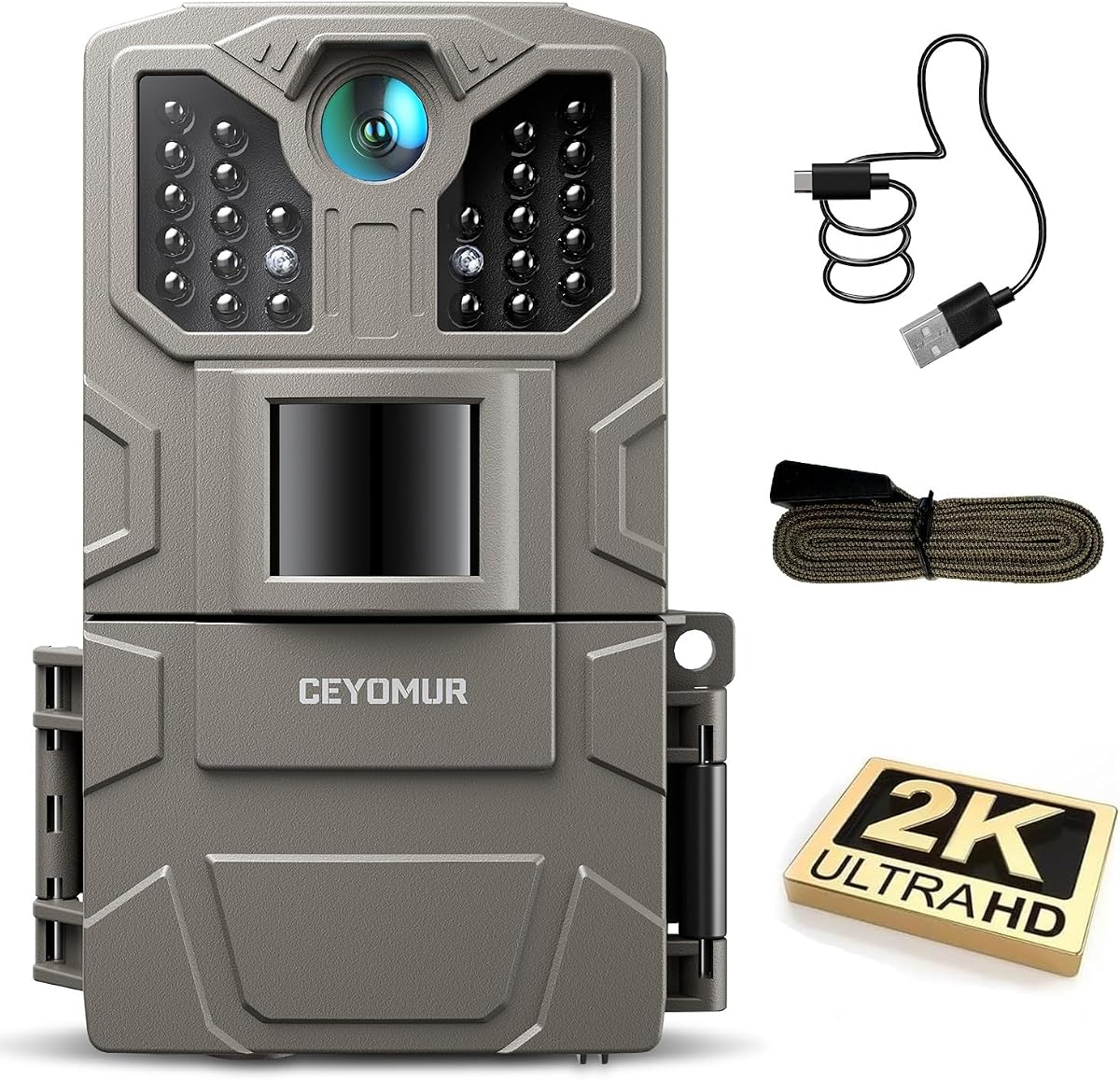
The CEYOMUR Trail Camera is designed for beginners with a 4.0 rating. It features an integrated design where lens screen and controls are on one side for easier setup. The camera records 36MP photos and 2K videos day and night. Powered by 8 AA batteries it provides reliable performance in rain dust or heat. This simplicity makes it accessible for first-time users who need dependable monitoring without technical hassle.
We may earn a commission when you buy through this link, at no additional cost to you.
Its powerful 850nm night vision produces bright images in complete darkness. The IP66 waterproof rating ensures reliability in extreme outdoor conditions. Controls are straightforward allowing anyone to start using it in minutes. It includes time-lapse and motion detection for versatile use. The compact build blends well into outdoor environments making it suitable for backyard or farm monitoring.
While durable it lacks advanced power options like solar support or cellular connectivity. Battery life is standard for its class requiring periodic replacement. The lack of premium features keeps the price low which is great for budget-conscious buyers. If you need a straightforward camera that just works in tough weather this model fits the bill well.
This camera is ideal for casual users or those new to trail cameras. Its durable build and simple operation make it a safe choice for basic needs. If you want a reliable device without complex settings the CEYOMUR delivers solid value. It is a practical tool for monitoring wildlife or property security affordably.
The integrated controls and screen allow quick adjustments in the field without needing to flip the camera.
IP66 protection keeps the internal electronics safe from water and dust ensuring consistent performance in storms.
We may earn a commission when you buy through this link, at no additional cost to you.
The WOSPORTS Mini 2 Pack offers great value with a 4.2 rating. It includes two cameras and 16GB SD cards making setup easier without extra purchases. Each camera runs on 4 AA batteries with low power consumption to extend standby time. The compact camouflage design helps it blend into forests and gardens. This kit allows you to monitor multiple locations simultaneously cost-effectively.
We may earn a commission when you buy through this link, at no additional cost to you.
Each unit captures 30MP photos and 1080P HD videos. The 850nm infrared LEDs provide clear night vision without disturbing wildlife. Fast trigger response ensures moving animals are captured quickly. Adjustable straps make installation on trees and posts simple. This package is ideal for property owners who need broad coverage without high unit costs.
The main limitation is the lack of solar compatibility which limits runtime in deep shade. Since each camera uses only 4 batteries power is efficient but still requires occasional replacement. The included SD cards save money but you might need more storage for high-volume recording. Overall it provides an affordable way to expand your monitoring network easily.
This pack is best for users needing multi-point surveillance. The low power design reduces battery replacement frequency. If you need to cover a large area cheaply this set offers a balanced solution. It is a smart investment for budget-friendly wide-area wildlife or security monitoring.
Buying a two-pack reduces the cost per unit allowing for broader coverage at a lower entry price.
Including SD cards saves immediate setup costs making it ready to use right out of the box.
We may earn a commission when you buy through this link, at no additional cost to you.
The WOSODA Mini Trail Camera 4 Pack provides a comprehensive solution with a 4.3 rating. It includes 4 cameras 16GB SD cards and 16 AA batteries so you are ready to deploy immediately. Each camera uses 4 AA batteries with low power consumption for extended standby time. This bundle is perfect for extensive property monitoring or large farms needing multiple angles. The compact camouflage design ensures it blends in naturally.
We may earn a commission when you buy through this link, at no additional cost to you.
Each camera captures 30MP photos and 1080P HD video. The 0.3s trigger speed ensures fast capture of movement. With 16 batteries included you have backup power for all units right away. The waterproof design handles rain and snow reliably. This complete kit removes the guesswork from buying accessories separately.
Like other mini models it lacks solar support which means relying on AA batteries for power. While efficient the need to replace batteries remains for continuous operation. However the included stock makes it convenient for initial deployment. If you want a plug-and-play solution for broad coverage this pack is very practical.
This bundle is ideal for large-scale monitoring projects. The included batteries and cards simplify setup significantly. If you need to watch multiple points cheaply and efficiently this set delivers. It is a smart choice for landowners seeking total coverage without complex setups.
Included batteries and SD cards mean you can start monitoring immediately after unboxing the package.
Four cameras allow simultaneous monitoring of different areas ensuring no wildlife activity goes unnoticed.
We may earn a commission when you buy through this link, at no additional cost to you.
The GardePro E5S 2-Pack offers powerful dual-camera efficiency with a 4.4 rating. Each unit supports 8 AA batteries and works with the GardePro SP350 Solar Panel for unlimited power. Non-Cellular and Non-WiFi operation ensures minimal power use. The cameras capture 64MP photos and 1296P HD videos smoothly. This set is ideal for monitoring two critical areas with high reliability and low energy consumption.
We may earn a commission when you buy through this link, at no additional cost to you.
Each camera features three PIR sensors for a 0.1s trigger speed. Flexible recording modes like Motion Detection and Time-Lapse allow customized usage. You can support SD cards up to 512GB for ample storage. The rugged IP66 waterproof design ensures longevity in harsh weather. Having two units allows better strategic placement without sacrificing performance.
A drawback is the higher initial investment compared to single cameras. Since there is no cellular connectivity you must retrieve data physically. However this reduces ongoing subscription costs significantly. If you prefer a self-contained system with long battery life the dual-pack is very cost-effective over time.
This set is best for serious hunters needing dual coverage. Its solar readiness and low power draw ensure long-term uptime. If you want high resolution and reliable performance across two spots this pack is a strong choice. It delivers consistent results for demanding outdoor environments.
Pairing with a solar panel ensures both units remain operational throughout the season without frequent battery swaps.
Using two cameras allows simultaneous tracking of different wildlife patterns for comprehensive data collection.
We may earn a commission when you buy through this link, at no additional cost to you.
Selecting the right trail camera requires understanding how power systems impact long-term performance. We explore key factors to help you maximize battery life for your specific deployment scenario.
The most critical factor is how the camera draws power. Standard models use 8 AA alkaline batteries but these deplete quickly in cold weather. Lithium batteries last longer but cost more. Solar panels offer the longest runtime if you have sunlight. Consider where you will place the camera to decide between disposable and renewable options.
Choose solar-ready models for remote sites. Alkaline batteries work well for short-term deployments. Always check battery compatibility before buying to avoid surprises.
Larger capacity batteries store more energy for longer runtimes. Models supporting eight AA batteries naturally last longer than those with four. Lithium packs offer high density and better cold weather performance. If you plan to leave the camera for months look for high-capacity external packs.
Look for cameras that accept 8 AA batteries minimum. Avoid models with non-replaceable internal batteries if you need long field life.
Solar charging allows for nearly indefinite operation in sunny conditions. Ensure the camera has a port for external solar panels or built-in panels. Built-in solar saves space but may be less powerful. External panels are often more efficient but require extra installation effort.
Pick a model with solar ports if you want to skip battery swaps. Verify panel compatibility before purchasing accessories.
Higher video resolution like 4K consumes more power and storage. If battery life is your priority lower resolution may save energy. Check if the camera has compression technologies to reduce file size. Balancing quality with power needs helps extend runtime.
Use lower video settings if you need maximum standby time. Prioritize image quality only for critical security zones.
Faster trigger speeds often mean higher power draw during active monitoring. A 0.1s trigger captures fast wildlife but uses more battery than a 0.5s model. Consider if you need rapid capture or just general monitoring. Many cameras allow adjusting sensitivity to save power.
Adjust motion sensitivity settings to reduce false triggers. This helps conserve battery life when animals pass by frequently.
Cellular cameras transmit data remotely but drain batteries much faster than non-cellular models. If battery life is critical choose non-cellular options. Wi-Fi models use moderate power for local transfers. Decide if you need remote access or just local storage.
Opt for non-cellular models if you want minimal power draw. Cellular adds convenience but reduces battery runtime significantly.
Waterproofing prevents damage that could lead to power leaks. Look for IP66 ratings to ensure rain and dust do not affect circuits. Moisture is a common cause of battery drain. Secure seals on battery compartments are essential for longevity.
Ensure the battery compartment seals tightly against elements. A good seal prevents moisture from shorting out your power supply.
Low standby power means the camera uses less energy when no motion is detected. This is crucial for long deployments. Models with sleep modes keep energy use low between triggers. Check manufacturer specs for power usage during idle periods.
Choose cameras with efficient power management modes. This keeps your battery charged for actual events rather than idle time.
Install the camera in a shaded area to prevent overheating which can drain batteries faster. Position it 3 to 4 feet high for optimal deer detection. Secure it to a sturdy tree with the included strap to prevent theft.
Use lithium batteries for cold weather deployments as they perform better than alkaline in low temperatures. Insert them carefully ensuring polarity is correct to avoid short circuits. Check the battery level indicators in the menu if available.
Clean the lens and solar panel regularly to remove dirt and leaves. Use a soft cloth to avoid scratching the surface. Ensure the camera vents are clear so heat does not build up inside the housing.
Use lithium batteries instead of alkaline for better performance. Set the camera to record short video clips. Enable sleep mode if available. Place the camera where it gets indirect sunlight to avoid overheating.
Not entirely. It depends on sunlight exposure. In heavy rain or winter the panel may not charge fully. Use a backup battery pack for consistent power during cloudy days to ensure reliability.
Yes especially in cold weather. Lithium batteries last up to three times longer than alkaline ones. They hold voltage better which prevents premature shutdowns. This makes them a smart investment for long monitoring periods.
Some cameras support rechargeable AA batteries but check the voltage. Standard NiMH batteries might not have enough voltage to trigger the camera. Use models specifically designed for rechargeable packs for best results.
This can happen if the camera is too sensitive to false triggers. Check the settings and lower the motion detection level. Also ensure the battery compartment is sealed tightly against moisture which causes leakage.
Place it where the solar panel faces south or receives direct sun most of the day. Avoid deep shade from trees. Tilt the panel slightly upward to catch rain runoff and sunlight effectively.
We reviewed ten top trail cameras focusing on power efficiency and endurance. The WOSPORTS Trail Camera offers the best overall value with flexible power options.
Prioritize solar compatibility if you plan to leave your camera for months at a time. For quick setups stick to lithium battery models to avoid frequent replacements.
Prices and stock change so check the latest offers before buying. These models provide reliable battery life for hunters and security needs alike.