
Diamond Antenna SP3000 Lightning Arrester – 200W, DC-3000MHz, N-Type Female/Female, Surge Protector for Ham Radio Antennas
4.8Editor score
200 Watt power handling capacity
DC to 3000 MHz coverage
1000 V impulse wave discharge
This guide compares the top antenna lightning arrestor models for protecting radios and cell boosters from surge damage during severe electrical storms.
Protecting your sensitive communication equipment from sudden electrical surges is essential for any antenna setup. A reliable lightning arrestor diverts dangerous voltage safely to ground before it reaches your transceiver or modem.
We compared ten highly rated surge protectors based on connector types, frequency range, and construction quality. Our selection covers UHF, N-type, and F-type options for mobile and base station applications.
Each pick highlights key features like insertion loss and gas discharge tube capacity. Please note that availability and pricing may change frequently on retailer websites.
4.8Editor score

4.8Editor score

4.5Editor score
The following table provides a side-by-side comparison of all ten selected arrestors to help you identify the right connector type and performance specs for your specific radio setup.


The RAIGEN Lightning Arrestor stands out as a top choice for protecting modern communication equipment from surge damage. With a high customer rating, it offers robust performance for cell boosters and WiFi access points.
We may earn a commission when you buy through this link, at no additional cost to you.
Its wide 0 to 6 GHz bandwidth covers everything from 5G LTE to LoRaWAN signals effectively. The replaceable 90V gas discharge tube ensures long-term protection without needing to replace the entire unit.
While the price is slightly higher than budget options, the included ground lug and weatherproof build justify the investment for permanent outdoor deployments. Users should ensure a grounding cable is purchased separately.
This arrester is ideal for IT installers and IoT builders who need reliable surge protection across multiple frequency bands. It provides peace of mind for valuable electronics in remote or exposed locations.
The wide bandwidth ensures that modern cellular signals and traditional ham radio frequencies are protected equally.
A replaceable gas discharge tube means you can maintain protection without discarding the entire arrester after a surge event.
We may earn a commission when you buy through this link, at no additional cost to you.
The Diamond Antenna SP3000 is a premium choice designed specifically for ham radio setups with significant power output. Its high rating reflects reliable performance and durable construction.
We may earn a commission when you buy through this link, at no additional cost to you.
It handles up to 200 watts of power while covering frequencies from DC to 3000 MHz. The N-Type connectors provide a secure connection suitable for base station environments.
While it lacks coverage beyond 3 GHz which limits some modern cellular applications, it is perfect for traditional radio operations. The impulse wave discharge capacity ensures strong protection against direct strikes.
This model is best suited for serious radio operators who need to protect expensive transceivers from high-energy surges. It delivers trusted protection for high power transmitting scenarios.
The 200W power handling capability makes this arrester suitable for transmitting stations without risking overheating.
N-Type connectors are known for their robustness, ensuring minimal signal loss and secure attachment to your coaxial cable.
We may earn a commission when you buy through this link, at no additional cost to you.
The Workman A28 offers essential surge protection for those seeking an affordable solution without complex features. It maintains a solid rating among users looking for simplicity.
We may earn a commission when you buy through this link, at no additional cost to you.
It features standard PL-259 connectors that fit common CB and Ham antenna lines. The included ground screw makes it easy to connect to your earth ground system directly.
While it lacks the detailed specifications of higher-end models, it provides a critical safety barrier for entry-level equipment. It is a practical choice for non-critical backup systems.
Buyers looking for a cost-effective way to add basic protection to their CB setup will find this unit valuable. It serves as a reliable first line of defense.
At a budget-friendly price, this arrestor allows hobbyists to protect equipment without a large upfront investment.
The straightforward design requires no special tools or knowledge to install in your existing radio system.
We may earn a commission when you buy through this link, at no additional cost to you.
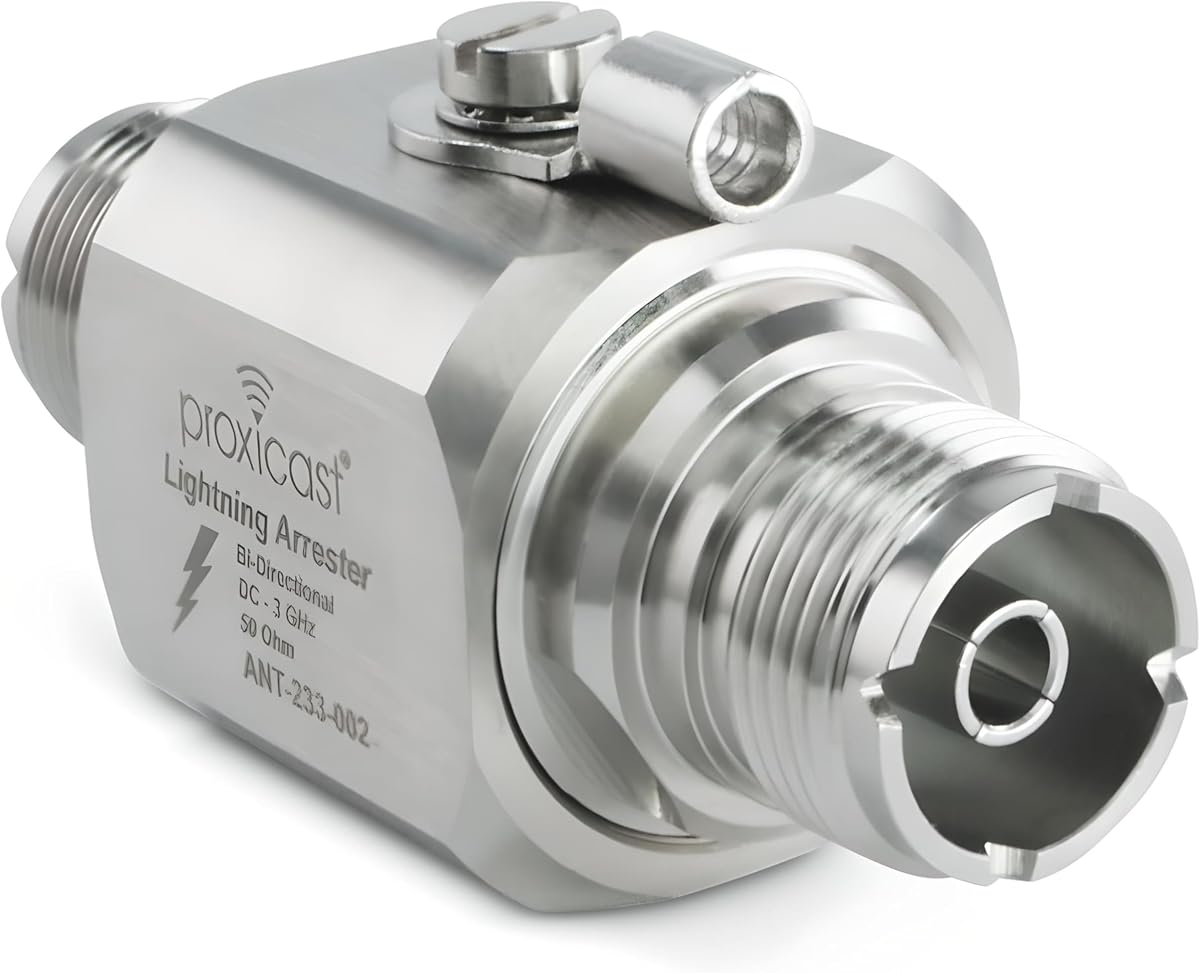
The Proxicast ProGrade arrester is designed for VHF and UHF applications using common SO-239 connectors. It earns a strong rating for its reliable protection capabilities.
We may earn a commission when you buy through this link, at no additional cost to you.
It features a 230V gas discharge tube that can handle multiple strikes effectively. The DC pass-through feature ensures continuous operation of powered antennas or devices.
While primarily focused on lower frequencies, it remains a solid choice for two-way radio and amateur setups. The low insertion loss preserves signal quality well.
This unit is ideal for users with existing SO-239 systems who want a dependable surge protector. It balances performance and cost for standard amateur radio needs.
The 230V tube is designed to activate during a surge and shunt energy to ground quickly.
Low RF insertion loss ensures your received signal strength remains high even with the arrester in line.
We may earn a commission when you buy through this link, at no additional cost to you.
This Proxicast model offers broader frequency coverage suitable for modern cellular and WiFi equipment. It holds a solid rating for protecting various radio devices.
We may earn a commission when you buy through this link, at no additional cost to you.
It covers frequencies up to 6 GHz making it compatible with 5G and 4G boosters. The N-Male and N-Female connectors allow easy inline installation.
Like its SO-239 version, it uses a gas discharge tube to divert energy. This makes it versatile for both traditional and modern signal setups.
Choose this arrester if you need protection for both ham radios and wireless networking gear. It offers a balanced approach to multi-use environments.
The broad 6 GHz range allows one arrester to protect multiple devices using different frequency bands.
Outdoor-rated construction ensures it can withstand exposure to the elements for long-term use.
We may earn a commission when you buy through this link, at no additional cost to you.
The Diamond SP1000 is designed for mobile and base stations where reliable surge protection is critical. Its high rating reflects consistent performance in demanding environments.
We may earn a commission when you buy through this link, at no additional cost to you.
With an impulse discharge capacity of 6000 Amps, it handles significant voltage spikes. The replaceable surge element means you can reset protection after a strike.
Its low insertion loss ensures your transmission quality stays high without attenuation. Weather-resistant materials provide long-term durability for outdoor mounting.
This unit is perfect for operators who need a premium arrester that lasts. The ability to replace the element saves money over time.
Handling up to 6000 Amps gives you confidence that extreme electrical surges will not damage your gear.
A replaceable element design simplifies maintenance, so you do not need to replace the whole unit frequently.
We may earn a commission when you buy through this link, at no additional cost to you.
The XRDS-RF UHF arrester focuses on maintaining a low VSWR to preserve signal efficiency. It is rated well by users who prioritize transmission quality.
We may earn a commission when you buy through this link, at no additional cost to you.
It uses brass nickel plating and a PTFE insulator to ensure stable connections. The VSWR under 1.2 ensures minimal signal reflection back to the radio.
While the frequency range is limited to 500 MHz, it is effective for standard CB and Ham bands. The female-to-female design fits directly into your cable line.
Choose this model if standing wave ratio is a concern for your setup. It offers reliable protection without compromising signal strength.
The low VSWR ensures your power output reaches the antenna rather than reflecting back to the transmitter.
Nickel plating prevents corrosion, ensuring the connectors remain usable for years of outdoor exposure.
We may earn a commission when you buy through this link, at no additional cost to you.
This N-type arrestor provides extensive frequency coverage including modern 5G and WiFi bands. It holds a high rating for its versatile protection capabilities.
We may earn a commission when you buy through this link, at no additional cost to you.
It operates from DC to 6 GHz making it ideal for diverse setups. The bi-directional protection ensures safety regardless of signal flow direction.
Low insertion loss is a key feature for maintaining data throughput on boosted signals. It uses a gas discharge tube for reliable shunting of energy.
Select this arrester for mixed setups involving both analog and digital signals. It is a strong choice for protecting GPS and LTE equipment.
The 6 GHz limit makes this suitable for current and upcoming cellular and wireless networking standards.
Bi-directional protection ensures safety is maintained even if signals travel in either direction through the line.
We may earn a commission when you buy through this link, at no additional cost to you.
This coaxial arrester is suitable for protecting walkie talkie and CB systems effectively. It maintains a strong rating for durable construction and reliability.
We may earn a commission when you buy through this link, at no additional cost to you.
It features a brass nickel-plated outer conductor to resist corrosion. PTFE insulation protects the inner core and ensures a stable connection.
The wide range of compatibility makes it a good fit for various base stations and satellite receivers. It can be mounted through an enclosure wall easily.
Choose this for simple setups needing weatherproof protection. It is a practical solution for home and portable communication gear.
Corrosion resistant materials ensure the unit remains functional even after long exposure to outdoor conditions.
The structure allows for easy mounting through walls which simplifies integration into buildings.
We may earn a commission when you buy through this link, at no additional cost to you.
This arrester is specifically designed for TV satellite and cable internet setups using 75 Ohm systems. It holds a solid rating for protecting home entertainment electronics.
We may earn a commission when you buy through this link, at no additional cost to you.
It uses F-Type connectors common in RG6 and RG11 cable installations. The gas discharge tube provides reliable protection against induced surges from lightning.
Bi-directional protection ensures safety regardless of where the surge originates. It also supports 4G and 5G boosters with 75 Ohm antennas.
Select this model if you need surge protection for your home television system. It offers a specialized solution for standard coax cable environments.
The 75 Ohm impedance matches standard home coaxial cable systems ensuring optimal protection for your setup.
Beyond TV, this unit can protect cellular boosters with matching impedance for comprehensive home coverage.
We may earn a commission when you buy through this link, at no additional cost to you.
Selecting the right arrester involves checking connector types, impedance, and frequency range to match your specific radio system.
Ensure the arrestor matches your existing cable connectors like SO-239, N-Type, or F-Type. Mismatched connectors can lead to poor contact and signal loss.
Always verify the connector gender such as male to female to fit your inline setup correctly.
Choose an arrester with the same impedance as your system, typically 50 Ohm for radios and 75 Ohm for TV. Mismatch causes reflection and signal degradation.
Matching impedance ensures efficient power transfer and protects your equipment from damage.
Check the frequency limits to ensure coverage for your specific signals. A wider range like 0 to 6 GHz covers both radio and modern cellular data.
Verify that the arrestor supports your operating frequencies to maintain signal integrity.
Look for models with high impulse wave discharge capacity to withstand severe strikes. Higher Amp ratings provide more reliable protection against direct hits.
Ensure the arrestor can handle the expected surge energy for your installation.
Most arrestors use gas discharge tubes to divert energy to ground. A replaceable tube allows you to reset the device after a surge event.
Check if the tube is replaceable to extend the useful life of the arrestor.
Low insertion loss is critical to prevent weakening your signal. Aim for less than 0.5 dB to maintain strong transmission and reception quality.
Select an arrestor with minimal loss to keep your signal strength consistent.
Since the arrestor is usually mounted outdoors, ensure it has weather-resistant materials. Brass plating or stainless steel helps prevent corrosion over time.
Look for ratings that confirm outdoor durability for long-term reliability.
Ensure the arrestor includes a ground screw or lug for proper earthing. Without a solid ground connection, the surge protection will not function effectively.
Always use a heavy-gauge ground wire to connect the arrestor to your earth system.
Install the arrestor between the antenna and your equipment with the antenna side facing the outdoor cable.
Attach a ground wire to the arrestor grounding screw and run it directly to your main ground rod system.
Inspect connections periodically for corrosion and ensure the ground path remains secure for optimal protection.
Yes, grounding the antenna alone may not protect your equipment from surges traveling through the coax cable. An arrestor provides a direct path to divert this energy safely.
Most quality arrestors have very low insertion loss meaning they do not noticeably affect signal quality. However, always check specs for minimal loss values.
The difference lies in the impedance matching. 50 Ohm is standard for radios while 75 Ohm is used for TV and cable. Using the wrong type causes reflection.
If it has a replaceable gas discharge tube, you can replace that part instead of the whole unit. Some arrestors may require replacement if the element is damaged.
Yes, arrestors are often compatible with signal boosters but ensure they support the booster's frequency range and impedance for optimal performance.
Ideally, install the arrestor as close to the entry point of the building as possible. This minimizes the length of cable inside the home that could carry a surge.
An arrestor helps divert surges but disconnecting equipment during severe storms provides the highest level of safety for valuable electronic gear.
Use a heavy-gauge ground wire such as 10-gauge copper to connect the arrestor to your main ground. Proper wire thickness ensures low resistance to ground.
This guide highlights top performers like the RAIGEN and Diamond Antenna models that offer reliable protection across various frequencies.
Prioritize impedance matching and connector types to ensure seamless integration into your existing antenna system.
Always check current availability and ensure you have a proper grounding path installed for maximum safety.