
SHILLEHTEK Universal Power Supply Module
4.6Editor score
Supports 6.5 to 12V DC input
Provides 3.3V and 5V outputs
Plugs directly into MB102 breadboards
Explore the top 12V breadboard power supply options for makers. This guide compares features, voltage outputs, and compatibility to help you choose the right
Finding the right power source is critical for any electronics project. A reliable 12V breadboard power supply ensures your components receive steady voltage without risk of damage. Whether you are building sensors or microcontrollers, stable power is the foundation of success.
We evaluated ten top-rated modules based on input flexibility, output current, and ease of use. Each product offers unique features like dual-channel control or USB compatibility. Our analysis helps you match the supply to your specific prototyping needs.
Each pick highlights key strengths and potential limitations for real-world use. Prices and availability change frequently so check current listings before buying. Use this guide to streamline your workspace and protect your valuable electronic components effectively.
4.6Editor score

4.5Editor score

4.8Editor score
The following table provides a side-by-side comparison of the top ten power supplies. It highlights key specifications like input range, output voltage options, and unique features to help you make an informed decision quickly.




This module stands out with its dual-channel design and USB-C input option. It receives high ratings for reliability and ease of use. The ability to power two rails independently makes it versatile for complex projects.
We may earn a commission when you buy through this link, at no additional cost to you.
The independent right and left channel control allows you to run 3.3V and 5V simultaneously. You can turn off one side without affecting the other. This flexibility is essential when testing circuits with mixed voltage needs.
While it offers excellent value, you may need to buy jumper wires separately. Also, the voltage is fixed so you cannot adjust it beyond 3.3V or 5V. These are minor trade-offs for the convenience and protection features offered.
Ideal for students and makers working on multiple boards. The 2-pack ensures you always have a backup. Buy this if you need a robust and flexible power distribution solution for your electronics lab.
Separate switches allow you to power different parts of your circuit with different voltages safely.
Support for Type-C USB means you can use standard phone chargers or power banks for testing.
We may earn a commission when you buy through this link, at no additional cost to you.
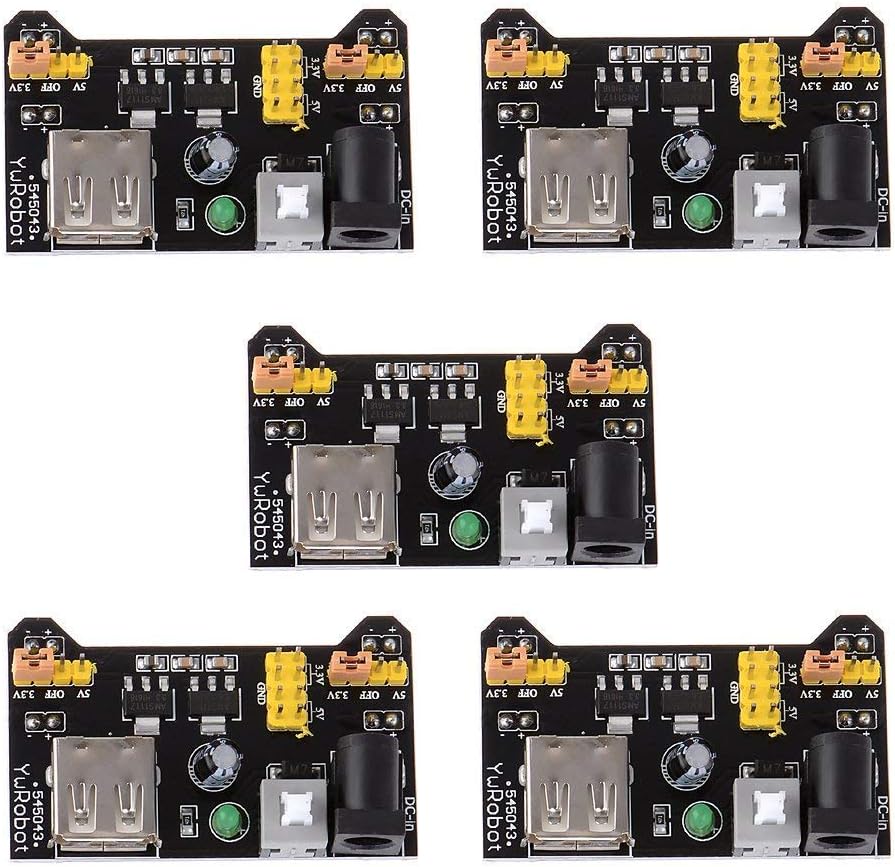
This kit offers five modules at a budget-friendly price. It is ideal for group projects or classrooms needing multiple supplies. The inclusion of 9V connectors adds flexibility for battery-powered tests.
We may earn a commission when you buy through this link, at no additional cost to you.
The modules support both DC and USB input. They fit standard 400 and 830 point solderless breadboards. However, the current limit is around 700mA which may not suit high-power components.
Some users report that the plastic casing can feel light. The fixed voltage is fine for standard logic but limits advanced use. Overall, it provides great value for basic prototyping needs.
Buy this if you need multiple units for students or backup. It is perfect for simple sensor projects. Check current voltage requirements before relying on the current limit.
Getting five units for this price makes it an excellent choice for educational settings or workshops.
The included 9V connectors allow you to power your breadboard without a wall adapter.
We may earn a commission when you buy through this link, at no additional cost to you.
This switching power supply offers exceptional flexibility with adjustable outputs. It supports inputs from 5V up to 40V. The multi-channel design ensures efficient power distribution for your projects.
We may earn a commission when you buy through this link, at no additional cost to you.
Unlike standard modules, this allows you to tune voltage. The LM2596 chip is known for efficiency. It handles higher input voltages better than linear alternatives.
You might need to solder wires to connect it. It also lacks visual status lights like others. These are acceptable trade-offs for the power and adjustability it provides.
Select this for advanced projects needing specific voltages. It is great for robotics or motor control. Ensure your setup can handle the input range safely.
Supporting up to 40V input means you can use a variety of power sources easily.
The adjustable channel lets you set exact voltage levels for unique components.
We may earn a commission when you buy through this link, at no additional cost to you.
This kit is designed for beginners who need everything in one box. It includes the breadboard, power module, and a 12V adapter. It removes the hassle of buying parts separately.
We may earn a commission when you buy through this link, at no additional cost to you.
The power module works well with Arduino and Raspberry Pi. However, the adapter stability can vary. The module current limit of 700mA is standard but may be tight for motors.
Some components might feel generic compared to premium brands. The jumpers are decent but could be higher quality. Still, it saves time on sourcing initial parts.
Choose this if you are new to electronics. It simplifies the setup process. Verify adapter ratings for your specific project needs.
You get the board module and adapter together so you can start building immediately.
Everything is pre-selected to match common microcontroller requirements.
We may earn a commission when you buy through this link, at no additional cost to you.
HiLetgo is a popular name in maker supplies. This pack provides five modules for a reasonable price. They are known for reliability and consistent performance.
We may earn a commission when you buy through this link, at no additional cost to you.
Each module offers 3.3V and 5V outputs. You can use DC or USB input. The design is simple with pins on the board.
It lacks individual switches for each rail. The voltage is fixed. These are standard trade-offs for this tier. Overall quality remains strong.
Buy this for reliable standard voltage needs. It is great for classrooms or personal use. Check if you need separate switches.
HiLetgo has a strong reputation for consistent module quality in the maker community.
The modules are small enough to fit on standard breadboards without taking much space.
We may earn a commission when you buy through this link, at no additional cost to you.
This module is a single unit but performs exceptionally well. It has high ratings for stability and reliability. It works seamlessly with common platforms like ESP32 and Arduino.
We may earn a commission when you buy through this link, at no additional cost to you.
The build quality uses high-quality components for efficiency. It supports dual inputs and standard outputs. It is designed for solderless breadboards for convenience.
You get only one module in the pack. You cannot adjust voltage beyond the preset levels. For most hobbyists this is not a major issue.
Buy this if you need a single reliable replacement. It offers high value for the price. Verify compatibility with your project voltage needs.
The module is built to ensure your project has stable power for longer test runs.
It integrates easily with MB102 breadboards to keep your setup tidy.
We may earn a commission when you buy through this link, at no additional cost to you.
This pack gives you five modules plus 9V connectors. It is ideal if you want to run portable tests. The LED indicator helps you see power status easily.
We may earn a commission when you buy through this link, at no additional cost to you.
The module uses a self-locking switch. It provides regulated output for stability. Current output stays below 700mA which is standard.
The switch design is convenient but sensitive. The current limit may restrict high-power uses. However for general electronics it is sufficient.
Buy this for battery-powered prototyping. It allows you to move projects without cords. Check power needs for your sensors.
The included 9V connectors let you power projects from batteries instead of wall adapters.
The green LED gives you a clear visual cue when the power rail is active.
We may earn a commission when you buy through this link, at no additional cost to you.
This kit is a project for those who want to build their own power source. It uses the LM2596 chip for adjustable voltage. It includes a digital display for clear readings.
We may earn a commission when you buy through this link, at no additional cost to you.
You can select from 3.3V 5V and 12V. It helps reduce wiring errors. The design is ideal for labs and makerspaces.
You need to solder components yourself. It is not ready to use immediately. This requires time and skill to assemble.
Buy this if you enjoy soldering. It is educational and useful. Ensure you have the necessary tools.
The built-in display lets you see the exact voltage before connecting your circuits.
Having multiple outputs on one board simplifies your breadboard layout.
We may earn a commission when you buy through this link, at no additional cost to you.
This module is designed for modern devices like Raspberry Pi. It provides higher current on the 5V rail. It is compact and easy to install.
We may earn a commission when you buy through this link, at no additional cost to you.
The USB output allows for extra flexibility. Independent channels offer stability. It is beginner-friendly and reliable.
It does not include a breadboard in the pack. The price is slightly higher than generic units. Still it delivers stable power.
Choose this for advanced microcontroller projects. It ensures enough power for Pi. Check current requirements before using.
The 1.5A output for 5V is great for devices that need more power.
Designed specifically for newer boards like Pico W and ESP32.
We may earn a commission when you buy through this link, at no additional cost to you.
This adapter is not a direct module but a versatile power source. It offers a wide voltage range and high power. It includes clips for connecting to bare wires.
We may earn a commission when you buy through this link, at no additional cost to you.
The LCD display shows voltage in real-time. It has many safety features and tips. It is excellent for powering various devices.
It requires connecting wires to the breadboard. It is not a standard board plug. However it offers high flexibility for power.
Buy this for high-power projects. It works for LED strips and motors. Check connector compatibility for your needs.
With 72W max power it can drive LEDs and motors easily.
Multiple tips and clips ensure you can connect to almost any device.
We may earn a commission when you buy through this link, at no additional cost to you.
Choosing the right power supply involves several factors. We break down the most critical aspects to help you find the best option for your needs.
Most modules provide fixed outputs of 3.3V and 5V. These cover most microcontroller needs. Some advanced modules offer adjustable output via a potentiometer or dial. Ensure the module supports the voltage your project requires.
Always verify that the output matches your component specs to avoid damage.
A good module accepts a range of input voltages. Look for DC 6.5V to 12V inputs. Some also support USB power. This flexibility lets you use various adapters or power banks.
A wider input range means you can use different power sources easily.
Current rating determines how much power you can draw. Standard modules provide up to 700mA. Higher-end ones might offer 1A or 2A per rail. Check your component needs to ensure the module can supply enough current.
Underpowering can lead to instability or brownouts.
Some modules allow you to control left and right rails separately. This is useful for testing dual-voltage circuits. Look for independent switches or jumpers for each rail. It adds flexibility to your workspace.
Independent channels save you from rewiring constantly.
Safety is critical for protecting electronics. Look for short-circuit and over-current protection. Some modules include thermal protection as well. These features prevent damage during wiring mistakes.
Always choose a module with safety features to protect your hardware.
Ensure the module fits your breadboard type. Most fit 400 or 830 point boards. The module should plug directly into the power rails. Some include 9V connectors for battery options.
Check connector types and board dimensions before buying.
Visual status LEDs help you know when power is on. They confirm which rails are active. This saves time when troubleshooting. Modules without LEDs require a multimeter check.
LEDs make it easier to monitor power status quickly.
Some packs include multiple units. Others offer a single unit with extra accessories. Evaluate if you need spare modules or a single reliable unit. Bulk packs are great for classrooms or groups.
Buy enough units to cover all your needs.
First insert the module into the power rails of your breadboard. Ensure the positive and negative pins align correctly. Most modules have clear markings on the bottom.
Next connect your power source via USB or DC adapter. Adjust voltage settings if your module allows it. Verify the output with a multimeter before connecting components.
Finally monitor the LEDs to confirm power. If using high power check for heat. Unplug the module when not in use to prevent drain.
Yes most modules accept 12V input and step it down to 5V or 3.3V. The module handles regulation internally. Always check the input range before connecting.
Standard modules offer up to 700mA per rail. Higher-end units may provide 1A or 2A. Exceeding the limit can cause shutdown or damage. Check specs before use.
Most are designed for Arduino and Raspberry Pi. They support 5V and 3.3V logic levels. Verify your specific board voltage requirements.
Look for indicator LEDs. If they do not light up the module may be in protection mode. Check wiring and connections. Most modules reset after disconnecting the short.
No standard modules are for logic and sensors. Motors often need more current. Use a dedicated motor driver for high power loads.
Most are not weatherproof. Indoor use is recommended. If using outside ensure dry conditions. Use a battery module for portable needs.
Check power source and input voltage. Ensure pins are inserted correctly. Try a different power supply. Some modules have fuses that may blow.
Yes they provide different voltages. 5V is for Arduino. 3.3V is for ESP32. Some modules allow separate control.
The 12V breadboard power supply is essential for reliable electronics. The top picks offer great value and performance for most users.
Prioritize independent channels and protection features. These ensure safety and flexibility during testing.
Always check current prices and specs before buying. Ensure you have enough power for your project.