
HiLetgo 5pcs DHT11 Temperature Humidity Sensor Module
4.5Editor score
Digital output single wire bus
Wide voltage input range
Includes five sensor modules
This guide compares the top Arduino temperature sensors including DHT11, SHT31, and DS18B20 models to help you choose the right humidity and temperature module.
Selecting the right sensor for your project is crucial for accuracy and reliability. Whether you are monitoring a greenhouse or tracking indoor climate conditions, the right device ensures your data is precise and your system performs optimally under varying environmental stress.
We evaluated ten popular modules based on accuracy, voltage range, connectivity options, and durability. Our analysis covers digital and analog options suitable for beginners and advanced makers alike. Each product was selected for its compatibility with standard microcontroller platforms and ease of integration.
Every pick highlights specific strengths like waterproofing, humidity tracking, or wide temperature ranges. We detail setup requirements and typical use cases to help you decide quickly. Please note that availability and pricing can change frequently on retailer websites so check current listings before purchasing.
4.5Editor score

4.4Editor score

4.7Editor score
This table offers a side-by-side look at all ten models to help you compare features quickly. Use it to identify which module matches your specific project needs regarding voltage, range, and connectivity requirements.



This module uses the DHT11 as a sensitive component to provide calibrated digital outputs for temperature and humidity readings. It features a bypass capacitor and pull-up resistor onboard to simplify your circuit design significantly.
We may earn a commission when you buy through this link, at no additional cost to you.
The single-wire wiring scheme allows you to integrate this sensor into other applications with minimal programming effort. You can connect it directly to microcontroller IO ports using the included wires for quick prototyping.
While the measurement accuracy is plus or minus five percent humidity and plus or minus two degrees Celsius, it remains sufficient for general environmental monitoring tasks. The resolution is one percent for humidity and one degree for temperature.
This pack of five modules is ideal for beginners who need multiple sensors for different locations or projects without breaking the bank. It offers full interchangeability and long-term stability for consistent performance over time.
The onboard components reduce external wiring needs making it perfect for school projects or hobby experiments.
With a long term stability of less than one percent humidity you can rely on consistent readings for months.
We may earn a commission when you buy through this link, at no additional cost to you.
The AHT30 module supports simultaneous online access to multiple I2C electronic devices which is great for complex sensor arrays. Its digital temperature and humidity measurement ensures accurate data collection for your microcontroller.
We may earn a commission when you buy through this link, at no additional cost to you.
With a DC supply voltage of 2.0 to 5.5V this sensor is easy to adapt to various power systems. It offers stable and fast transmission speeds with a temperature accuracy of plus or minus zero point three degrees Celsius.
The 4P test line connection is designed for convenience allowing you to set up the module quickly without soldering. You get two sensors in this package making it cost-effective for dual monitoring points.
This upgraded version replaces older models like AHT20 or AHT10 providing better performance for your Arduino projects. The resolution reaches zero point zero one degrees Celsius for very fine temperature tracking.
Supports master output configuration allowing multiple sensors on the same bus without complex wiring.
Designed to consume minimal energy making it suitable for battery powered remote monitoring applications.
We may earn a commission when you buy through this link, at no additional cost to you.
This module uses the SHT31-D which offers a wide operating voltage of 2.4 to 5.5V allowing compatibility with many boards. It provides precise temperature measurement from minus forty to one hundred twenty five degrees Celsius.
We may earn a commission when you buy through this link, at no additional cost to you.
Humidity measurement ranges from zero to one hundred percent relative humidity with an accuracy of plus or minus two percent. The I2C interface output ensures reliable digital data transfer for your control systems.
Accuracy is maintained at plus or minus zero point three degrees Celsius making it ideal for demanding applications. You receive three modules in this pack which is great for multi-node setups.
The wide voltage range and accurate measurements make this a top choice for professionals needing reliable data over time. It ensures high stability and consistent performance in varying environmental conditions.
Works with both 3.3V and 5V systems reducing the need for extra voltage regulators in your circuit.
Delivers precise readings suitable for climate control systems or scientific monitoring projects.
We may earn a commission when you buy through this link, at no additional cost to you.
The pluggable DS18B20 temperature probe is designed to be easy to plug and use in various environments. It features a pull-up resistor on board so you can connect directly to most microcontrollers without extra parts.
We may earn a commission when you buy through this link, at no additional cost to you.
Widely used for monitoring fish tanks or greenhouses it withstands wet conditions well. The adapter module simplifies connection with red black and yellow leads clearly marked for power and data.
The measuring range spans from minus fifty five to one hundred twenty five degrees Celsius which covers most industrial needs. You get three sets in this pack providing good value for multiple zones.
This is a solid choice for thermally sensitive systems requiring reliable waterproof sensors. The wide applications include thermostatic controls and consumer products making it versatile for many uses.
Suitable for aquariums or industrial machinery where moisture and corrosion resistance are required.
Includes a board with resistor so you save time on soldering or external components.
We may earn a commission when you buy through this link, at no additional cost to you.
The DS18B20 waterproof probe is designed for underwater use and can operate in wet environments without damage. It offers a wide temperature range of minus fifty five to one hundred twenty five degrees Celsius with high accuracy.
We may earn a commission when you buy through this link, at no additional cost to you.
Supply voltage ranges from three to five point two five volts which fits most microcontrollers. Wiring is simple with red yellow and black leads for VCC Data and GND connections.
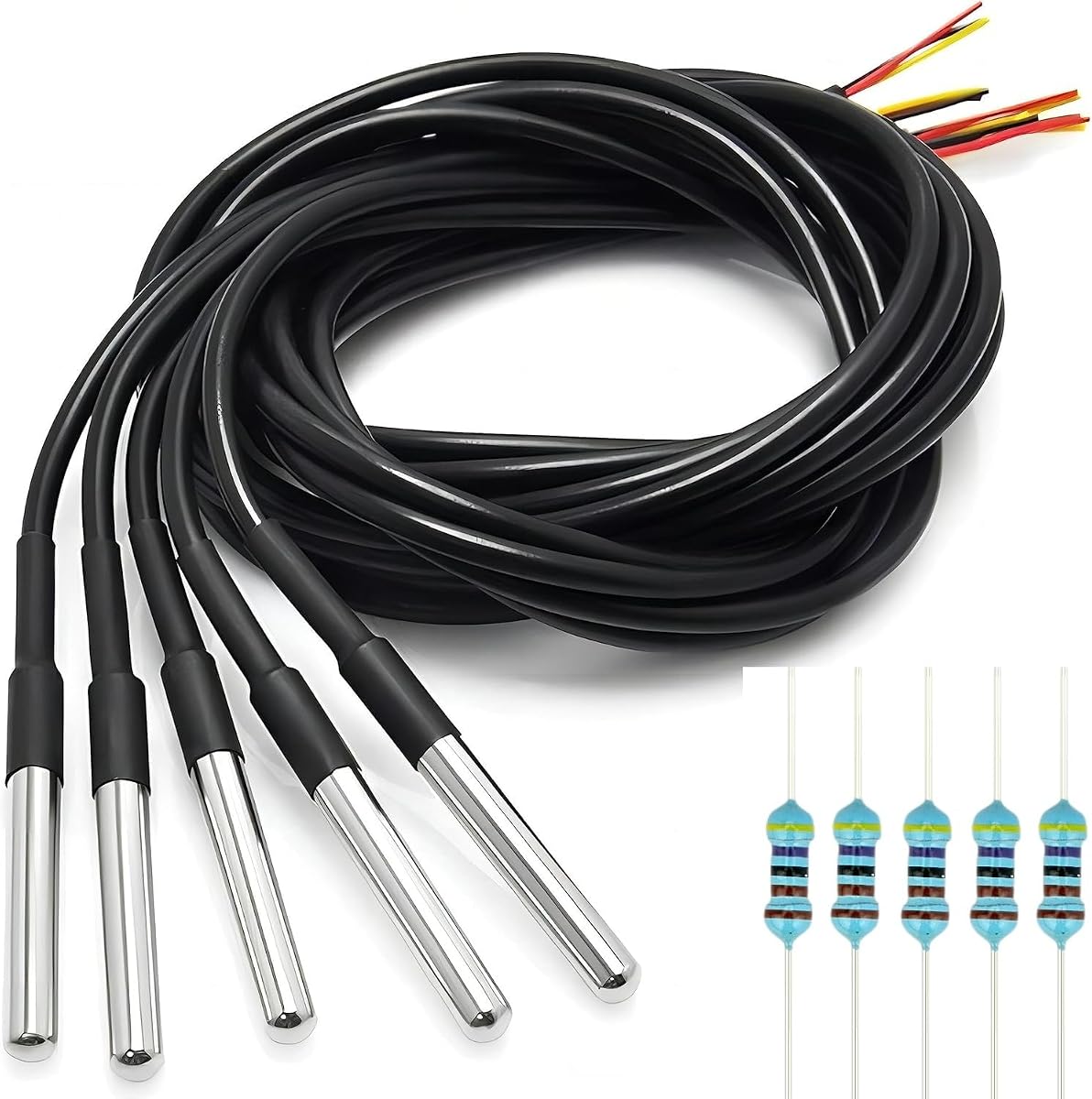
This pack includes five sensors and five resistors which helps you set up multiple nodes quickly. It is compatible with Arduino Raspberry Pi and ESP32 boards for flexible development.
The stainless steel package ensures durability in harsh conditions. With the included resistors you can quickly test without extra components making it a strong value for DIY projects.
Each probe comes with a resistor so you can start coding immediately without hunting for parts.
Supports Arduino and Raspberry Pi ecosystems making it easy to fit into existing setups.
We may earn a commission when you buy through this link, at no additional cost to you.
This digital temperature and humidity sensor is a digital signal output with a calibrated combined sensor. It uses dedicated digital modules to ensure high reliability and excellent long-term stability in your projects.
We may earn a commission when you buy through this link, at no additional cost to you.
The sensor consists of a resistive element and an NTC temperature device connected to a microcontroller. This allows the single-wire wiring scheme to integrate easily with other applications without complex code.
Humidity measure range is twenty to ninety five percent with temperature measure range zero to fifty degrees Celsius. You get two modules with wires for easy connection to your microcontroller ports.
It is ideal for basic home monitoring or educational purposes where precision is less critical. The simple protocol reduces programming effort so you can focus on other aspects of your build.
Designed with high-performance components to maintain accuracy over extended periods of use.
The digital output makes it easy to send data to Wi-Fi modules for remote monitoring.
We may earn a commission when you buy through this link, at no additional cost to you.
The stainless steel probe is encased in waterproof corrosion-resistant material with a thermally conductive sealant. This makes it perfect for continuous submersion and harsh conditions like outdoor industrial sites.
We may earn a commission when you buy through this link, at no additional cost to you.
Delivers precise temperature readings from minus fifty five to one hundred twenty five degrees Celsius with accuracy of plus or minus zero point five degrees. The wires are clearly separated for quick integration.
It features red yellow and black leads with heat shrink tubing for safe connections. The adapter board includes a pull-up resistor enabling direct connection without external parts.
This low power kit operates on a wide voltage range ensuring compatibility with various development boards. The 1-Wire interface simplifies communication while providing robust and stable data streams.
Includes jumper wires and resistors so you can build a complete sensor setup instantly.
The adapter board simplifies wiring to standard GPIO ports reducing risk of connection errors.
We may earn a commission when you buy through this link, at no additional cost to you.
The power supply range is 3.0V to 5.5V with a probe length of approximately 100cm per unit. You get a pack of 5pcs which is perfect for large scale monitoring projects needing multiple sensors.
We may earn a commission when you buy through this link, at no additional cost to you.
Output leads are clearly marked red yellow and black for VCC Data and GND. The unique single bus interface means you can chain multiple sensors on one wire reducing wiring clutter.
It is ideal for thermostatic controls industrial systems or any thermally sensitive system requiring high precision. The warm tip suggests using a 4.7K resistor to make testing easier.
This module is designed to operate reliably in wet or moist environments. Its simplicity and bulk value make it a favorite for industrial installations needing many temperature points.
The 100cm probe length lets you monitor hard-to-reach areas without extending wires manually.
Connect multiple probes on one digital line saving IO pins on your microcontroller board.
We may earn a commission when you buy through this link, at no additional cost to you.
This module uses the AOSONG AM2302 chip which provides high sensitivity for temperature and humidity readings. It features a single-bus digital signal output with bidirectional serial data for reliable transmission.
We may earn a commission when you buy through this link, at no additional cost to you.
Temperature range spans from minus forty to eighty degrees Celsius with accuracy of plus or minus zero point five degrees. Humidity measuring range covers zero to one hundred percent with accuracy of plus or minus two percent.
It includes fixing screw holes for convenient installation which helps keep the sensor steady in your project. You get two units for this package making it cost-effective for dual sensor setups.
This sensor replaces older models like SHT11 offering better performance for electronic practice. Its digital output makes it easy to integrate with modern microcontroller platforms and libraries.
The screw holes on the module make it easy to secure the sensor in place permanently.
Uses AM2302 technology which provides superior accuracy compared to older DHT11 variants.
We may earn a commission when you buy through this link, at no additional cost to you.
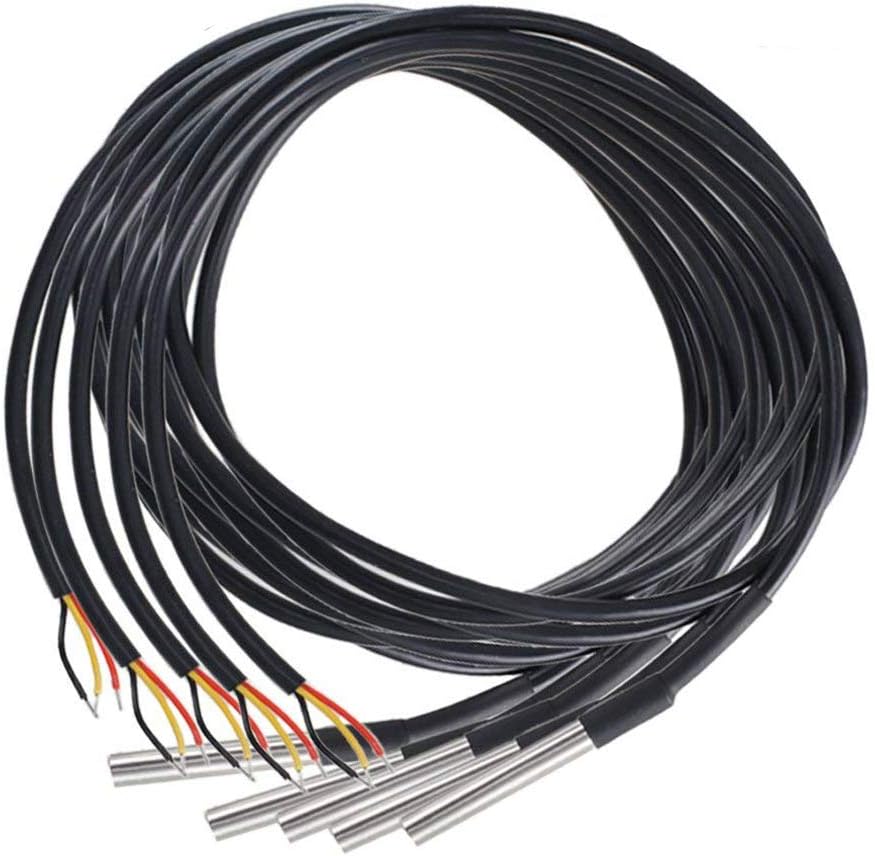
This pack includes five DS18B20 temperature sensor cables with probes in stainless steel packaging. Each probe comes with a one meter length providing flexibility for placement in your project.
We may earn a commission when you buy through this link, at no additional cost to you.
Wiring is straightforward with red yellow and black for VCC Data and GND. The wide temperature range of minus fifty five to one hundred twenty five degrees Celsius covers most use cases.
Supply voltage operates between three and five point five volts which suits most microcontrollers. You should use a 4.7K resistor between Data and VCC for easier testing.
The waterproof cable ensures reliability in moist environments. Getting five probes at this price makes it a great value for large scale monitoring or distributed sensor networks.
The cable is waterproof allowing it to be submerged without damaging the internal sensor.
Runs on standard 3.3V or 5V rails making power supply planning easy for most projects.
We may earn a commission when you buy through this link, at no additional cost to you.
Selecting the right module depends on your project requirements and budget. Here are key factors to consider.
If you need precise control over a system like a greenhouse or incubator prioritize sensors with accuracy of plus or minus zero point five degrees Celsius or better. DHT22 and SHT31 offer better precision than DHT11.
For basic hobby projects DHT11 is often sufficient and more affordable.
Ensure the sensor matches your microcontroller's operating voltage. Most support 3.3V to 5V but some like SHT31 allow up to 5.5V for extra flexibility.
Check your board specs to avoid voltage mismatches that could damage the sensor.
I2C sensors like SHT31 allow multiple devices on two wires while 1-Wire options like DS18B20 offer long cable runs. Choose based on wiring complexity.
DHT series use single-wire but are slower in data transfer.
For wet environments choose waterproof probes like DS18B20 which are sealed against moisture and corrosion.
Dry indoor projects can use bare modules without protection.
Industrial applications may need wide ranges from minus forty to one hundred twenty five degrees Celsius while home use typically needs zero to fifty degrees.
Check the limits to ensure the sensor survives your environment.
If you need humidity data choose combined sensors like DHT11 or SHT31. Pure temperature sensors like DS18B20 do not measure humidity.
Combined modules save space and wiring.
Bundles of five are cost-effective if you need multiple sensors. Individual units may be better for testing new types.
Calculate total budget based on unit count.
Modules with adapter boards simplify connections by including resistors and terminals. Bare probes need soldering.
Beginners should favor boards for quicker setup.
Install the sensor securely to avoid physical stress. Use mounting holes or clips to keep wires from pulling on the probe.
Calibrate your system by comparing readings with a known accurate thermometer and adjust code offsets if needed.
Keep the probe away from direct heat sources and sunlight to ensure accurate ambient temperature data.
The DHT22 or SHT31 modules are excellent for indoor humidity tracking due to higher accuracy. DHT11 is cheaper but less precise. Ensure you use a library that supports the specific module.
Yes waterproof DS18B20 probes are designed for submerged use. Check the waterproofing rating before submersion. The stainless steel probe resists corrosion well.
Yes a 4.7K resistor is required between Data and VCC for 1-Wire communication. Some boards include this onboard to save wiring.
Connect SDA to SDA and SCL to SCL on your board. Power VCC to 3.3V or 5V and GND to GND. Use an I2C scanner library to verify connections.
DS18B20 has a fast response compared to DHT sensors. DHT11 is slower with updates every two seconds. Check datasheets for exact refresh rates.
SHT31 supports 2.4V to 5.5V making it ideal for variable power. DS18B20 works from 3.0V to 5.5V. DHT11 needs 3.3V to 5V.
DHT11 accuracy is plus or minus five percent humidity and plus or minus two degrees Celsius. It is good for general use but not precise control.
Our top picks include the HiLetgo DHT11 for budget projects and the Gikfun DS18B20 for waterproof needs. The Teyleten SHT31 offers premium accuracy for professional use.
Prioritize accuracy and environmental protection for your specific use case. Ensure voltage and interface compatibility with your microcontroller.
Prices and availability vary so check current listings before ordering. Select a module that grows with your project needs.