
ESP8266 ESP-01S WiFi Module
4.4Editor score
4MB flash memory capacity
Stronger signal reception
Low power consumption
This guide compares the top ten Arduino WiFi modules for embedded projects, evaluating connectivity options, processing power, and ease of use for makers.
Arduino WiFi modules enable seamless internet connectivity for your embedded projects. Choosing the right one depends on your project needs, budget, and required features like Bluetooth support or dual-core processing capabilities.
We evaluated ten leading options based on connectivity stability, processing power, ease of integration with Arduino IDE, and community support. Our analysis covers everything from compact ESP8266 units to powerful dual-core boards.
Each pick highlights specific strengths, trade-offs, and ideal use cases for your next build. Prices and availability can fluctuate frequently, so verify current details before purchasing your components.
4.4Editor score

4.7Editor score

4.5Editor score
Compare the key specifications of the top ten Arduino WiFi modules side by side to find the best fit for your specific embedded development requirements and constraints.



The Arduino UNO R4 WiFi is our top choice for advanced projects needing powerful processing. It combines a Renesas RA4M1 microcontroller with an ESP32-S3 Wi-Fi chip, offering dual-core performance and 4.7-star ratings from users.
We may earn a commission when you buy through this link, at no additional cost to you.
Its standout quality lies in the integrated 12×8 LED matrix and robust wireless connectivity via Bluetooth 5.0 and Wi-Fi. The board supports CAN bus for industrial applications and includes a 12-bit DAC for precise analog output.
Trade-offs include a higher price than basic ESP modules and a steeper learning curve due to the dual-core architecture. However, these are acceptable for developers needing reliable edge AI or high-speed data processing.
This board is ideal for makers building complex IoT systems or interactive displays. If you need reliable wireless control and modern interfaces, the UNO R4 WiFi is the best overall solution.
The combination of Renesas RA4M1 and ESP32-S3 allows for real-time data processing while maintaining stable wireless connections simultaneously.
The built-in LED matrix eliminates the need for external displays to show status indicators or simple text messages.
We may earn a commission when you buy through this link, at no additional cost to you.
The HiLetgo 3pcs ESP8266 ESP-01 bundle offers an affordable entry point into WiFi connectivity. With a 4.2 rating, these modules provide reliable wireless transceiver capabilities for hobbyist projects.
We may earn a commission when you buy through this link, at no additional cost to you.
Each module includes powerful on-board processing and storage. You can configure them in AP, STA, or AP+STA modes, allowing flexible networking options. They work seamlessly with the Arduino IDE using standard AT commands.
These modules lack headers and require external power management due to 3.3V tolerance. This can complicate prototyping without a separate adapter, but for small projects they remain highly cost-effective.
Buy this if you need multiple reliable units for large sensor networks. It is perfect for makers needing connectivity without breaking the bank or dealing with complex microcontrollers.
Supporting AP, STA, and AP+STA modes allows the module to connect to routers or act as a hotspot for other devices.
The small form factor makes these modules easy to hide inside enclosures or wearable electronics without taking up space.
We may earn a commission when you buy through this link, at no additional cost to you.
The ESP8266 ESP-01S is the best budget option for basic connectivity needs. Rated 4.4 stars, it offers 4MB flash memory and improved signal strength over older versions.
We may earn a commission when you buy through this link, at no additional cost to you.
It provides robust processing capabilities and supports both AP and STA modes. The module is compatible with Arduino IDE when you select Generic ESP8266 Board during setup, making coding straightforward.
Limited GPIO pins and lack of USB interface mean you need breakout boards or converters. These constraints are acceptable given the very low cost and reliability of the ESP8266 chip.
Choose this if you need simple web interfaces or sensor data logging. It is ideal for projects where cost per unit matters and complex features aren't required.
The latest 01S version improves antenna design for more reliable connections in areas with weaker router signals.
4MB flash allows storage of larger sketches and local web pages without external memory modules.
We may earn a commission when you buy through this link, at no additional cost to you.
The Aitrip 5pcs ESP8266 ESP-01 kit is perfect for bulk projects needing multiple identical nodes. With a 4.4 rating, these modules offer reliable serial WiFi transceiver performance.
We may earn a commission when you buy through this link, at no additional cost to you.
Each unit supports AP and STA modes and runs on 3.3V. They are designed for smart grids, IoT, and industrial control applications where many small sensors are needed simultaneously.
Be careful with power supply voltage to avoid damage. Lack of USB interface means external serial adapters are necessary. These constraints are manageable for developers familiar with ESP8266 basics.
Buy this if you are building large sensor networks. It is ideal for projects requiring multiple units for testing or distributed sensor deployment.
Having five units allows rapid deployment across different locations or simultaneous testing of multiple sensor nodes.
The modules support dynamic clock scaling which helps extend battery life for remote monitoring projects.
We may earn a commission when you buy through this link, at no additional cost to you.
The ELEGOO 3PCS ESP-32 Dev Boards provide powerful dual-core performance at an accessible price. Rated 4.7, these boards combine WiFi and Bluetooth 4.2 on ESP-WROOM-32 modules.
We may earn a commission when you buy through this link, at no additional cost to you.
You can run complex processing and wireless communication simultaneously. USB-C ports allow efficient power delivery and sketch uploads. OTA updates let you deploy firmware changes without unplugging devices.
Power consumption is higher than ESP8266 chips. The lack of a included USB cable adds a small extra cost. These are minor issues for developers needing significant processing power.
Choose this if you need advanced embedded tasks with wireless links. It is best for home automation projects or smart devices needing local Bluetooth support.
Dual cores running at 240MHz allow for real-time signal processing alongside active network connections.
Built-in Bluetooth 4.2 enables pairing with mobile apps or other Bluetooth sensors without extra hardware.
We may earn a commission when you buy through this link, at no additional cost to you.
The Arduino Nano ESP32 Without Headers is ideal for rapid prototyping with Python. Rated 4.5, it features ESP32-S3 dual-core processing and MicroPython compatibility.
We may earn a commission when you buy through this link, at no additional cost to you.
It supports Bluetooth 5.0 and HID profiles, allowing creation of custom input devices like keyboards. The USB-C port ensures stable connections and faster programming than older micro-USB models.
Requires soldering headers for stable breadboard use. Higher price compared to ESP8266 modules is justified by the extra features and modern design. These trade-offs are acceptable for professional development.
Buy this if you prefer Python or need custom USB peripherals. It is best for developers needing fast wireless communication and flexible scripting options.
Interactive coding and quick iteration in Python make prototyping easier than traditional C++ sketch development.
Enables the board to act as a keyboard or mouse, useful for security projects and automation interfaces.
We may earn a commission when you buy through this link, at no additional cost to you.
The ESP8266 ESP-01S WiFi Module Pack offers four reliable units for small projects. Rated 4.4, these modules use self-calibrated RF for optimal performance in wearable electronics.
We may earn a commission when you buy through this link, at no additional cost to you.
They support home automation and sensor networks efficiently. The reusable material construction ensures durability. Each module is compact enough to fit inside tight enclosures.
Limited GPIO pins restrict complex wiring. Breakout adapters are needed for easy connections. These constraints are minor given the small size and RF stability.
Choose this if you need multiple modules for distributed sensors. It is ideal for wearable tech or compact smart home devices.
Self-calibrated RF ensures reliable wireless connections even in environments with interference.
Durable materials allow repeated soldering and reuse for iterative prototyping sessions.
We may earn a commission when you buy through this link, at no additional cost to you.
The 5PCS ESP8266 ESP-01S WiFi Serial bundle provides five units with 4MB flash. Rated 4.5, these modules offer robust IoT WiFi transceiver capabilities.
We may earn a commission when you buy through this link, at no additional cost to you.
They support DOUT protocol for reliable serial communication. Select Generic ESP8266 Module in Arduino IDE and set SPI mode to DOUT. Baud rate is 115200 for stable transfers.
Voltage tolerance is limited to 3.3V, risking damage with 5V. USB interface is missing, requiring FTDI adapters. These are acceptable trade-offs for developers needing bulk units.
Buy this if you need multiple nodes for large IoT networks. It is best for smart home projects needing numerous sensors or relay control.
The DOUT protocol ensures reliable flash memory communication when programming the module via external interfaces.
Ample space for storing local web server files and larger firmware binaries without external memory.
We may earn a commission when you buy through this link, at no additional cost to you.
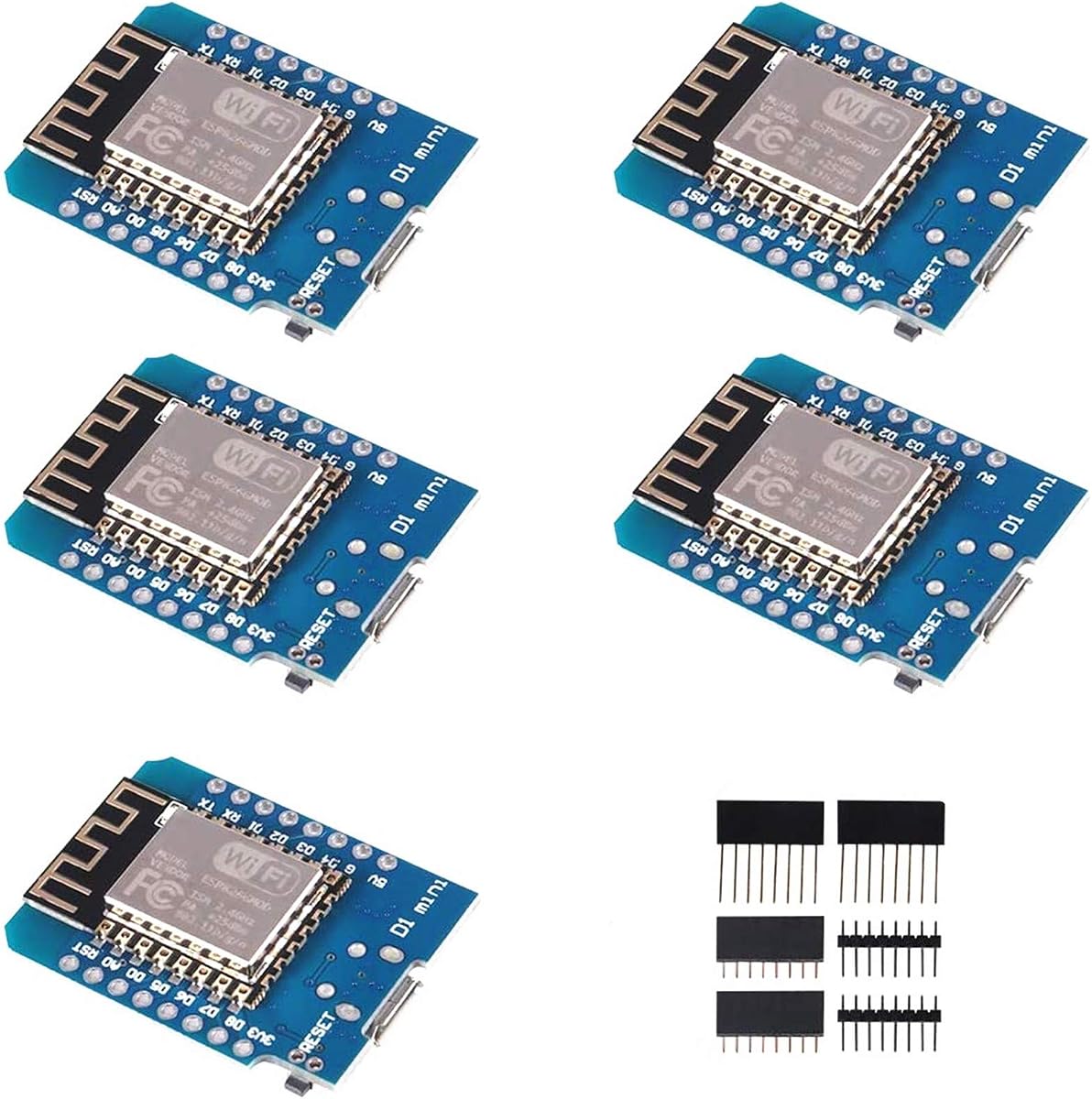
The 5pcs ESP8266 ESP-12F NodeMcu Mini offers 11 GPIO pins. Rated 4.5, these D1 Mini modules provide extensive I/O support and Micro USB connections.
We may earn a commission when you buy through this link, at no additional cost to you.
They support Arduino IDE programming and have onboard switching power supplies. The 500mA resettable fuse protects against power spikes. All pins support PWM and I2C except D0.
Micro USB cable is not included. Soldering headers is required. These are minor inconveniences given the flexible I/O options and affordable five-pack pricing.
Buy this if you need extensive GPIO for multiple sensors. It is best for home automation projects with many input/output devices.
With eleven GPIO pins, you can connect multiple sensors, relays, or displays simultaneously.
The onboard switching power supply and fuse protect the board from voltage spikes and unstable power sources.
We may earn a commission when you buy through this link, at no additional cost to you.
The 10-Pack ESP8266 ESP-01 Serial WiFi offers ten units at a bulk price. Rated 5.0, this bundle is ideal for large-scale sensor networks.
We may earn a commission when you buy through this link, at no additional cost to you.
Modules support AP and STA modes with LWIP protocol. They provide robust processing and storage capabilities. The compact transceiver design fits easily into small enclosures.
Requires external breakout boards for easy connections. GPIO pins are limited. These constraints are acceptable given the extreme bulk value and reliability.
Choose this if you need many nodes for testing. It is perfect for prototyping large IoT systems or educational kits.
LWIP implementation simplifies networking code in Arduino IDE, making development easier for complex protocols.
The small form factor ensures these modules fit into almost any project enclosure without adding bulk.
We may earn a commission when you buy through this link, at no additional cost to you.
Selecting the right Arduino WiFi module requires considering connectivity, power, processing, and form factor. Below are key factors to guide your choice.
Check if the module supports Wi-Fi, Bluetooth, or both. Some options like ESP32 offer Bluetooth, while ESP8266 focuses on Wi-Fi. Ensure compatibility with your network protocols.
Prioritize modules with Bluetooth 5.0 if proximity sensing or peer-to-peer communication is needed.
Dual-core processors like ESP32-S3 handle complex tasks better than single-core ESP8266. For edge AI or real-time data, dual-core offers smoother performance.
Choose higher MHz clocks and cores if your project involves heavy data processing alongside wireless tasks.
Flash memory affects how much code and data you can store. Modules with 4MB flash allow larger sketches than 1MB units. Consider your application size.
Look for ample flash capacity if you plan to store local web servers or large datasets locally.
Many WiFi modules run on 3.3V. Applying 5V can damage them. Ensure your power supply or logic level converters match this requirement to avoid hardware failure.
Select modules with stable voltage ranges if using unregulated power sources or batteries.
Modules come in small transceivers or development boards with headers. Small units save space but require adapters. Boards with headers simplify prototyping.
Pick boards with headers if you prefer breadboard testing without soldering adapters.
Support for LWIP, AP, or STA modes allows flexible networking. Ensure your code or libraries support these protocols for seamless integration.
Verify protocol support in your chosen IDE to avoid compatibility issues during development.
For battery-powered projects, look for modules with low-power modes. ESP32 and ESP8266 both offer sleep modes to extend battery life significantly.
Choose low-power options if your project needs to run for months without recharging or battery replacement.
Modules with USB-C or built-in converters simplify uploads. Others require separate FTDI adapters or external breakout boards.
Prioritize modules with USB ports if you want a streamlined workflow without extra hardware.
Install required drivers for USB interfaces in Arduino IDE. Select the correct board model to match your module's chipset. Ensure firmware is up-to-date for best performance.
Avoid exposing modules to extreme heat or humidity. Keep connections secure with proper headers. Regularly check solder joints to prevent loose contacts during operation.
If modules fail to connect, verify power supply and signal strength. Reset the module or switch AP/STA modes as needed. Use serial monitors for debugging communication issues.
The ESP32 and ESP8266 ESP-01S both offer good range. The ESP32-S3 in Nano ESP32 provides Bluetooth 5.0 for better range. Antenna design also plays a key role in distance performance.
Yes. Add ESP8266 board manager URL in IDE preferences. Select Generic ESP8266 Module and upload sketches. Ensure correct COM port and baud rate settings.
Solder headers to expose pins for connections. Use USB-C cable to connect to PC. Select ESP32 board in IDE and upload. Ensure board manager supports your module.
ESP8266 and ESP32 both support deep sleep modes. For lowest power, use ESP8266 with optimized code. Ensure you configure sleep cycles properly to save energy.
Nano ESP32 supports MicroPython directly. Other modules may need MicroPython firmware flashed. Use compatible IDE settings and libraries to run Python scripts.
For simple sensors, one module is enough. For multiple nodes, use packs like 5 or 10 units. Plan for testing spares to avoid downtime if modules fail.
STA connects module to router. AP creates own hotspot. AP+STA combines both. Choose based on whether device needs to connect or broadcast WiFi network.
Use OTA libraries in Arduino IDE. Upload first via USB then update remotely. Ensure stable connection. Verify board supports OTA features before starting.
We highlighted the Arduino UNO R4 WiFi for performance and ESP8266 ESP-01S for budget. Each module offers unique features for different project scales.
Prioritize connectivity stability, power needs, and programming ease. Choose dual-core if you need advanced processing or Bluetooth support for modern devices.
Prices change frequently so verify current listings before buying. Always check voltage and power requirements to ensure safe operation in your setup.