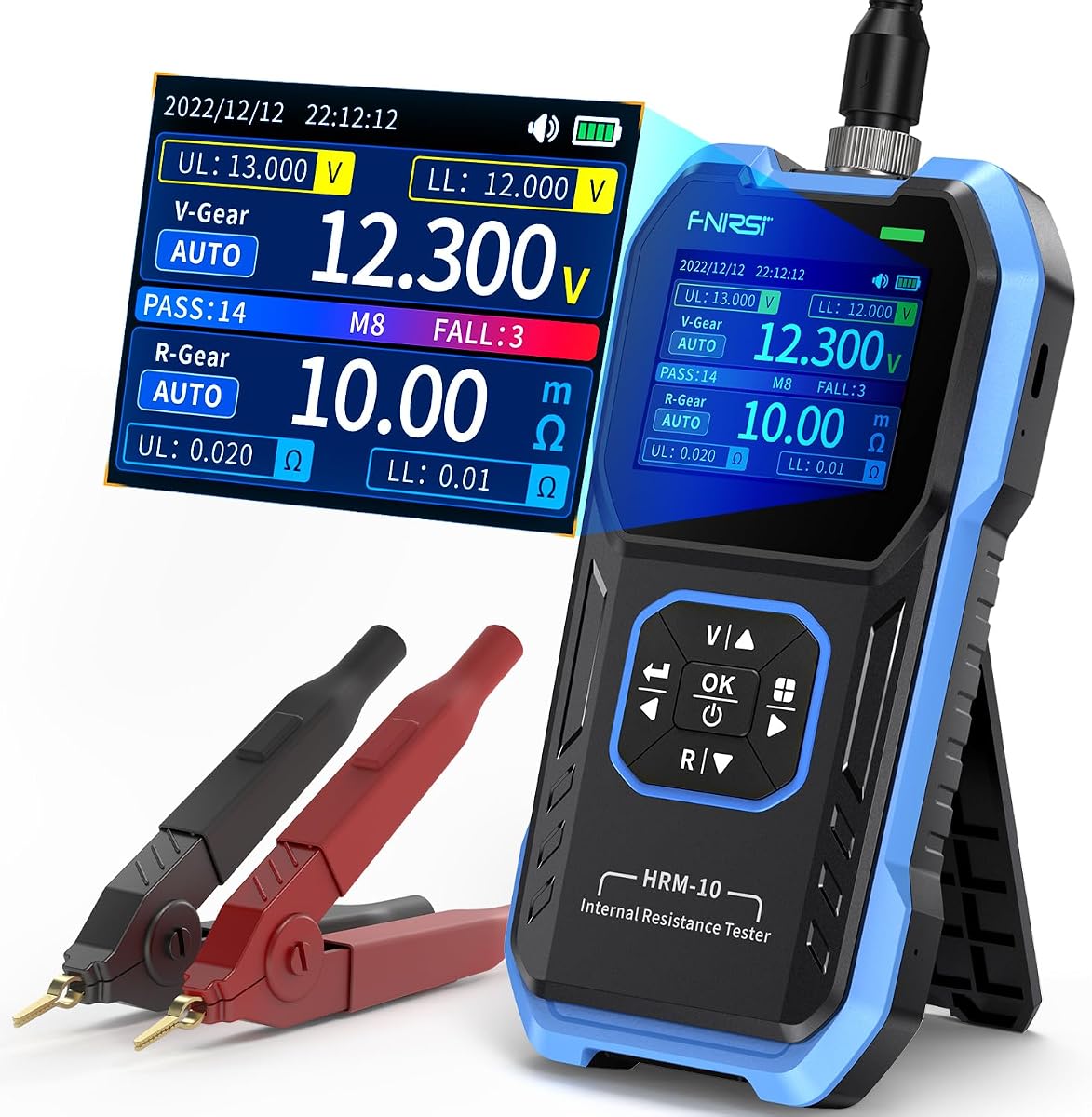
FNIRSI HRM-10
4.4Editor score
TFT HD color display
Up to 100V voltage
Data export to PC
This guide compares the top ten Battery Internal Resistance Tester models for accurate diagnostics across automotive, industrial, and consumer electronics
Finding a reliable Battery Internal Resistance Tester is essential for anyone who relies on batteries for critical applications. These devices provide precise measurements that indicate health and performance better than voltage alone.
We compared ten leading models based on accuracy, features, build quality, and user feedback. Each product offers unique advantages for different needs ranging from hobbyists to professional technicians.
Each pick highlights key strengths and ideal use cases to help you choose wisely. Prices and availability change frequently so always verify details before making your final purchase decision.
4.4Editor score

4.5Editor score

5.0Editor score
The following table provides a quick side-by-side comparison of all ten products to help you identify the model that best fits your specific testing requirements.




The ZOYI ZT-XR1 stands out as a versatile tool combining a professional multimeter with dedicated internal resistance testing. It holds an impressive 4.5 rating from users who appreciate its dual functionality and high-resolution display.
We may earn a commission when you buy through this link, at no additional cost to you.
Its standout feature is the integration of a 25000-count True RMS multimeter with a dedicated battery testing mode. The 4-wire Kelvin sensing ensures precise measurements even for low resistance values which is critical for identifying aging batteries quickly.
While it offers extensive features like waveform recording and data logging, the interface can be complex for beginners. The bilingual menu supports Chinese and English which may limit usability for some regions.
This device is ideal for electricians and DIY hobbyists who need a single tool for both general repairs and battery diagnostics. Its robust build and safety ratings make it a reliable choice for daily use.
The 4-wire Kelvin sensing eliminates lead resistance errors providing highly accurate readings for critical battery health assessments.
Saving storage space and cost this unit replaces two devices allowing seamless switching between multimeter and battery tester modes.
We may earn a commission when you buy through this link, at no additional cost to you.
The FNIRSI HRM-10 is a popular choice for budget-conscious users seeking reliable internal resistance testing. With a strong 4.4 rating it delivers solid performance for automotive and household battery diagnostics without breaking the bank.
We may earn a commission when you buy through this link, at no additional cost to you.
Its key strength lies in the advanced color HD display which presents test results clearly compared to traditional monochrome screens. The device supports historical records and data export making it easy to track battery performance over time.
While it lacks an internal rechargeable battery requiring external power during testing, this keeps the device light and simple. The measurement range is adequate for most common applications but may fall short for very high voltage industrial batteries.
This tester is perfect for homeowners or small workshop owners who need accurate readings for car and household batteries. Its ease of use and data tracking features make it a practical tool for regular maintenance.
The TFT HD color display makes reading resistance and voltage values intuitive and reducing eye strain during prolonged testing sessions.
Exporting test results to a PC allows for better analysis of battery degradation trends which is vital for predictive maintenance.
We may earn a commission when you buy through this link, at no additional cost to you.
The YR1035+ commands a perfect 5.0 rating reflecting its exceptional performance and user satisfaction among professionals. It is designed for precise diagnostics in both field and bench testing environments.
We may earn a commission when you buy through this link, at no additional cost to you.
Its standout feature is the true four-wire testing system which ensures that lead resistance does not affect the internal resistance measurement. This accuracy is crucial when testing sensitive lithium or lead-acid batteries where small differences matter.
While the device is slightly more expensive than basic models the precision justifies the cost for serious users. The compact design makes it easy to carry but users should note it requires an external power source during operation.
This tester is best suited for engineers or technicians who demand the highest accuracy for battery configuration and performance testing. Its reliability and portability make it a trusted tool for critical applications.
Separating voltage and current paths allows for exact internal resistance readings eliminating errors caused by probe contact resistance.
The lightweight construction ensures you can carry it easily to remote locations without adding significant weight to your toolkit.
We may earn a commission when you buy through this link, at no additional cost to you.
The Dlyfull Universal Tester offers a user-friendly solution for checking common household and electronic batteries. Its 4.4 rating highlights its reliability for everyday tasks like checking batteries for toys or remote controls.
We may earn a commission when you buy through this link, at no additional cost to you.
The device supports 11 battery types including AA AAA and button cells making it versatile for home use. The large LCD screen clearly displays capacity percentage helping you decide if a battery needs replacement or charging.
While it provides basic internal resistance detection it lacks the advanced features found in professional models. The rotary dial selection requires manual adjustment which can be slower than automatic detection in higher-end testers.
This tester is ideal for homeowners who need a quick and easy way to maintain their battery stash. Its simplicity and wide compatibility make it a convenient tool for general household maintenance.
The percentage readout gives an immediate idea of remaining power reducing guesswork during battery replacement decisions.
Supporting common sizes ensures you can test almost any standard battery found in consumer electronics without needing multiple tools.
We may earn a commission when you buy through this link, at no additional cost to you.
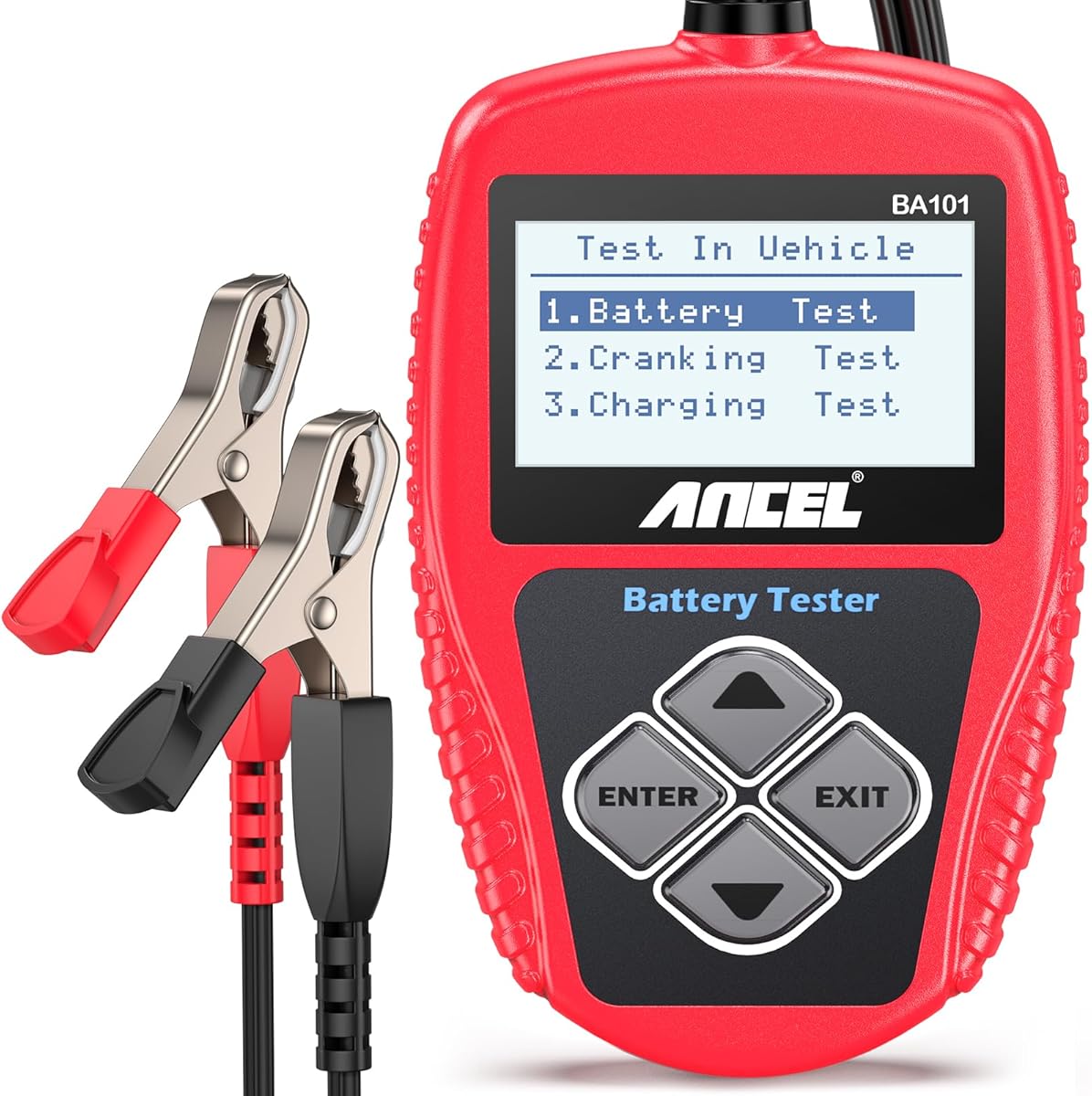
The ANCEL BA101 is a specialized tool designed for accurate 12V automotive battery and alternator testing. With a 4.5 rating it is favored by mechanics and vehicle owners for its dependable diagnostic capabilities.
We may earn a commission when you buy through this link, at no additional cost to you.
It provides detailed readings for State of Health and State of Charge which are critical for predicting battery life. The test is powered directly from the vehicle eliminating the need for internal batteries or charging.
While it excels for automotive use it is not suitable for lithium packs or voltages other than 12V. Users must enter battery type data manually which requires careful attention to ensure accurate results.
This device is perfect for car enthusiasts or fleet managers who need reliable data to prevent unexpected breakdowns. Its protection features and clear display make it a safe and easy choice for vehicle maintenance.
Providing SOH and SOC metrics helps diagnose issues that simple voltage checks might miss ensuring reliable vehicle starts.
Drawing power from the vehicle battery simplifies storage and ensures the device is always ready when you need it.
We may earn a commission when you buy through this link, at no additional cost to you.
The ZOYI XR1 combines internal resistance testing with a high-resolution multimeter to serve as a versatile diagnostic tool. It holds a 3.9 rating reflecting mixed user feedback regarding its interface and specific features.
We may earn a commission when you buy through this link, at no additional cost to you.
It features a 25000-count display and Type-C charging which modernize the user experience significantly. The adjustable buzzer and auto-shutdown settings offer customization options for different work environments.
However the interface and usability are rated lower than competing models by some users. The accuracy is good but the design and ergonomics may not appeal to everyone seeking a polished professional tool.
This tester is a good option for budget users who need a multimeter with battery testing capabilities. It is suitable for general electronics repair and basic battery checks in home workshops.
The Type-C charging interface allows quick power top-ups using standard cables reducing downtime during extended field work.
Adjustable buzzer volume ensures that audible alerts do not disturb nearby equipment or colleagues in quiet environments.
We may earn a commission when you buy through this link, at no additional cost to you.
The RC3563 is a highly rated handheld analyzer known for its intelligent control and high precision measurements. It achieves a 4.9 rating thanks to its efficient use of the Kalman filter algorithm for stable readings.
We may earn a commission when you buy through this link, at no additional cost to you.
Its standout feature is the built-in 1000mAh battery which allows for portable testing without external power. The device can measure AC resistance of capacitors and resistors adding value for electronics hobbyists.
While it offers excellent performance the LCD screen and design are somewhat basic compared to newer color display models. Users who prioritize data stability and lightweight portability will likely overlook these cosmetic trade-offs.
This device is perfect for scientific research or maintenance tasks requiring high precision in a small package. It is a favorite among hobbyists who value accuracy and battery life over modern aesthetics.
The Kalman filter algorithm filters out noise ensuring stable and repeatable readings for critical battery diagnostics.
With a built-in battery and light weight the device is easy to carry around for spot checks on various battery types.
We may earn a commission when you buy through this link, at no additional cost to you.
The T-685 offers high precision measurements suitable for laboratory environments or specialized industrial applications. It holds a lower 2.2 rating likely due to its specialized nature and high cost which may not suit general users.
We may earn a commission when you buy through this link, at no additional cost to you.
Its key strength is the 1u Ohm resolution and AC DC resistance capability which allows for detailed analysis of battery packs. The USB port enables easy data logging and integration with computer systems for advanced tracking.
Despite its technical capabilities the low user rating suggests potential issues with usability or support. The device is heavy and requires AC power which limits its portability for field use.
This tester is best for laboratories or specialized industries requiring ultra-precise internal resistance data. It is less suitable for general automotive or consumer battery testing where lower precision tools suffice.
Measuring resistance down to 1u Ohm provides detailed insights into battery cell health that standard testers cannot detect.
USB connectivity allows for seamless transfer of test data to software for detailed batch analysis and record keeping.
We may earn a commission when you buy through this link, at no additional cost to you.
The YR1035 Square variant offers a specialized version of the popular YR1035+ with accessories designed for easier handling. It holds a perfect 5.0 rating reflecting user satisfaction with its precision and convenience.
We may earn a commission when you buy through this link, at no additional cost to you.
Its standout feature is the clamp design that allows for hands-free testing of battery lugs and positive electrodes. This convenience is valuable for repetitive tasks where holding probes manually is impractical or fatiguing.
While the core performance matches the standard model the specific clamp accessory may vary in quality depending on the combination package. Users should check the specific listing to ensure it includes the needed probes.
This tester is ideal for users who test many batteries at once and want to save effort on probe handling. It is a great addition to a workshop where speed and hands-free operation are priorities.
Using clamps allows you to monitor readings while adjusting connections or logging data simultaneously without distraction.
The Type-C port enables charging from phones or computers reducing the need for proprietary power adapters in travel.
We may earn a commission when you buy through this link, at no additional cost to you.
The WESTOBIG Tester is an upgraded model focusing on precision Kelvin sensing to ensure accurate low resistance measurements. It holds a 4.3 rating from users who value its reliability for automotive and household battery checks.
We may earn a commission when you buy through this link, at no additional cost to you.
Its key feature is the Kelvin four-terminal sensing which eliminates lead resistance interference. The device allows users to preset 8 sets of data for quick pass or fail checks against industry standards.
While the display is functional it lacks the high definition color screens of some competitors. The auto mode and preset checks make it efficient for batch testing without needing manual adjustments every time.
This tester is well suited for auto shops or technicians who need consistent and accurate data for client reports. Its robust measurement system makes it a dependable choice for professional battery maintenance.
Separating current and voltage paths ensures that even sub-ohm resistances are measured accurately without wire interference.
Presets allow quick comparison against standard values saving time when testing multiple batteries in a single session.
We may earn a commission when you buy through this link, at no additional cost to you.
Selecting the right Battery Internal Resistance Tester requires understanding key features that impact accuracy and usability. This guide breaks down the most important factors to consider.
Accuracy is the most critical factor as it determines how reliable your battery health assessment will be. Look for testers that use 4-wire Kelvin sensing to eliminate errors caused by lead resistance.
Prioritize devices with high resolution and low tolerance ranges to ensure precise readings for your specific battery types.
Ensure the tester supports the full range of voltages and resistances for the batteries you plan to test. Most common tools cover 0 to 100V and 0.1m Ohm to 200 Ohms which suits many consumer and automotive needs.
Check the maximum input ratings to avoid damaging the device when testing higher voltage industrial or automotive packs.
A clear and readable display is essential for interpreting complex data quickly. Color TFT screens offer better visibility and contrast than basic LCDs especially in varying lighting conditions.
Look for adjustable brightness and intuitive layouts to reduce eye strain during extended testing sessions.
Modern testers often include features like data logging or export capabilities to track battery health over time. USB connectivity or PC software allows you to store historical records for analysis.
Prioritize models with preset data checks if you need to validate batches of batteries against specific standards quickly.
Some devices rely on internal rechargeable batteries while others draw power from the device under test or an external source. Internal batteries add weight but ensure portability in field environments.
Consider models with Type-C charging for convenience and universal compatibility with modern power supplies.
Safety features such as overload protection and reverse polarity guards are vital to prevent accidents during testing. A robust housing protects the device from drops and environmental exposure.
Check for appropriate safety ratings like CAT II or CAT III if you plan to use the tool in industrial or automotive settings.
If you need to move the tester between locations or use it on-site consider the size and weight of the unit. Compact handheld models are easier to transport than larger benchtop units.
Ensure the weight is balanced well to make handling probes and clips comfortable during prolonged use.
Higher priced models often offer better accuracy and features but may not be necessary for casual users. Determine your required precision level to avoid overspending on capabilities you won't use.
Consider the warranty and customer support options provided by the manufacturer as a sign of product reliability and longevity.
Always ensure the battery is disconnected from any load before testing to get an accurate internal resistance reading. Connect the probes or Kelvin clips to the positive and negative terminals carefully to ensure solid contact.
Select the appropriate voltage range or allow the device to auto-range based on the battery type. Press the test button and wait for the display to stabilize before recording the resistance and voltage values.
Store the tester in a dry and clean place to protect the electronics from moisture or dust. Clean the probes regularly with a soft cloth to prevent corrosion which can affect measurement accuracy over time.
Internal resistance provides a true indicator of battery degradation that voltage alone cannot show. A battery may read full voltage under no load but fail under load if its internal resistance is high. This test reveals aging cells that voltage checks miss entirely.
2-wire testing includes the resistance of the test leads in the measurement which reduces accuracy. 4-wire Kelvin testing separates voltage and current paths to eliminate lead resistance errors. This makes 4-wire testing essential for measuring low resistance values accurately.
Yes most modern testers support lithium batteries but you must ensure the voltage range matches your pack. Always check the manufacturer's guidelines for specific battery chemistry compatibility. Some testers require manual settings for lithium cells.
It is recommended to test your car battery at least twice a year especially before extreme weather seasons. Regular testing helps predict failures before they leave you stranded. Testing during routine vehicle maintenance is also advisable.
Many universal testers can measure internal resistance on alkaline or primary batteries to assess their remaining life. However the readings may be less critical compared to rechargeable chemistries. It is useful for determining if a disposable battery is truly dead.
A healthy car battery usually has an internal resistance below 5 milliohms but this varies by age and size. Values above 20 milliohms often indicate the battery is nearing the end of its useful life. Always compare readings to the manufacturer's specifications.
Variations can occur due to temperature changes probe contact quality or battery load conditions. Ensure the battery has rested without load before testing for consistent results. Check that your probes are clean and making firm contact with the terminals.
Most portable testers are designed for low voltage systems typically up to 100V. Using them on higher voltages without proper rating can damage the device or cause injury. Always verify the maximum voltage rating before testing industrial systems.
Choosing the right Battery Internal Resistance Tester depends on your specific application needs and precision requirements. The ZOYI ZT-XR1 offers the best all-around versatility while the FNIRSI HRM-10 provides excellent value for budget users.
Prioritize accuracy and safety features when selecting a model for professional or automotive use. Investing in a tester with 4-wire Kelvin sensing ensures reliable data that protects your equipment and vehicle batteries.
Always verify current prices and availability before purchasing as market conditions change frequently. The models highlighted in this guide represent the top options for most users in 2026.