
Calibrite Display 123
4.0Editor score
Easy 1 2 3 software workflow
Supports up to 2 displays
Compact body with USB C connection
Compare the top 10 colorimeters for monitor calibration to find the best device for accurate screen color across photo editing, video grading, and creative
Finding the right colorimeter for monitor calibration is essential for creators who demand accuracy. Whether you edit photos or grade video, consistent color ensures your work looks correct on any device. These tools measure screen output and adjust settings to match industry standards.
We compared ten leading models based on sensor quality, software features, and display compatibility. Our list covers budget-friendly options, professional HDR tools, and complete workflow kits. Each product was evaluated on ease of use, accuracy, and support for modern screen technologies like OLED.
Every pick shows specific strengths for different user needs and budget levels. Some focus on speed while others offer deep control for professionals. Remember that prices change often, so check current listings before buying to ensure you get the best value available now.
4.0Editor score
4.5Editor score

4.0Editor score
This side-by-side comparison highlights the key specifications and strengths of each model. Use this table to quickly identify which colorimeter fits your specific display type and workflow needs before diving into detailed reviews below.


The Calibrite Display 123 is a practical colorimeter designed for users who want accurate screen color without complexity. It holds a strong rating for its approachable interface and reliable performance. This device is ideal for photo editors needing consistent tones across sessions.
We may earn a commission when you buy through this link, at no additional cost to you.
Its main strength lies in the guided 1 2 3 workflow that simplifies calibration steps. The software corrects common color shifts and allows brightness targets like Native or Photo. You can also calibrate two monitors to ensure matching colors in a multi screen workspace.
While it lacks advanced video grading tools, the trade-off keeps the device simple and fast. The built-in Before After Check view helps you confirm results quickly without needing deep technical knowledge. Regular use maintains consistency for your editing environment.
Buyers should choose this if they prioritize ease of use and dual monitor support. It is perfect for photographers and creators starting with color management. The compact body and USB C connection make it easy to set up anywhere you work.
The guided software makes calibration fast and approachable for non experts.
Support for two displays ensures matching colors across your workspace.
We may earn a commission when you buy through this link, at no additional cost to you.
The Calibrite Display Plus HL stands out as a top choice for professionals working with high luminance displays. Its advanced HL sensor measures up to 10000 nits ensuring accurate calibration for HDR capable monitors. This tool is essential for video editors needing consistent highlights.
We may earn a commission when you buy through this link, at no additional cost to you.
The included PROFILER software offers deep control over white point gamma and luminance. You can support custom patch sets and shared presets for team workflows. Validation tools like Profile Validation and Uniformity Check help you trust the final result fully.
Although it is more expensive, the ability to handle mini LED and XDR panels justifies the cost. Video standards support including Rec.709 and BT.1886 makes it suitable for broadcast pipelines. The built-in tripod mount adds flexibility for projector calibration too.
Professional video editors and colorists should consider this model for its HDR capabilities. It delivers reliable grading decisions and clean blacks on super bright screens. The comprehensive software and hardware make it a powerful investment for high-end production.
Measures up to 10000 nits for accurate calibration of ultra bright displays.
Includes Profile Validation and Uniformity Check to ensure reliable results.
We may earn a commission when you buy through this link, at no additional cost to you.
The datacolor Spyder is designed to meet the demands of today's digital workflows including OLED and mini LED displays. It calibrates screens in about 90 seconds making it incredibly fast for daily use. The DevicePreview feature lets you see how photos look on other devices.
We may earn a commission when you buy through this link, at no additional cost to you.
Its ambient light sensor tracks room conditions and adjusts display brightness automatically. This prevents eye strain and maintains accuracy as lighting changes throughout the day. The software offers pre-set options for beginners and custom settings for professionals.
While it may lack some deep professional controls found in other tools its speed and ease of use are unmatched. The ability to warn about recalibration based on light levels adds a layer of convenience. It ensures your starting point is always accurate.
Ideal for photographers and designers who want quick reliable results without fuss. The Spyder balances simplicity with powerful features for modern screens. Trust it to keep your viewing environment consistent regardless of external lighting conditions.
Simulates what photos look like on other devices on your calibrated screen.
Tracks room light to adjust brightness and maintain ideal viewing levels.
We may earn a commission when you buy through this link, at no additional cost to you.
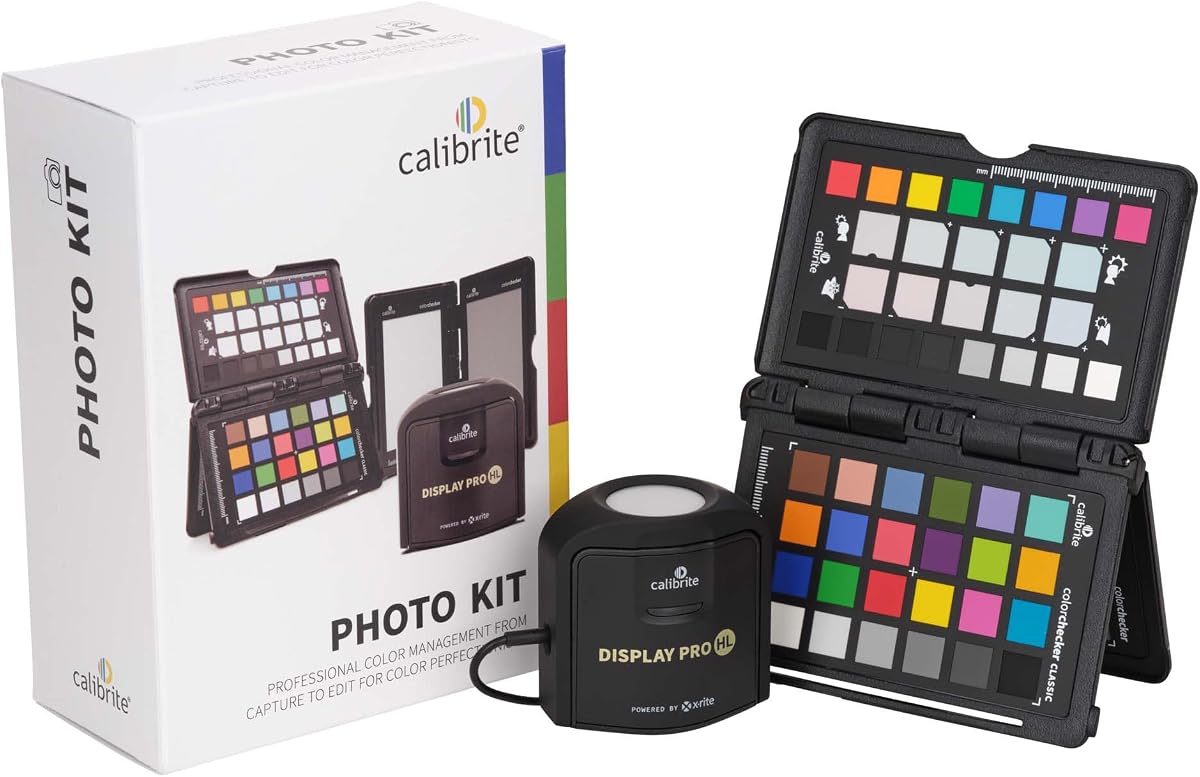
This kit combines the Display Pro HL colorimeter with the ColorChecker Passport Photo 2 for a full photo workflow. It creates a consistent process from capture through editing ensuring reliable results across locations. The Display Pro HL supports modern panels including mini LED and Apple XDR.
We may earn a commission when you buy through this link, at no additional cost to you.
Custom camera profiles for RAW workflows help maintain accurate white balance and exposure references. This reduces color guesswork and unwanted shifts before you start grading or retouching images. The PROFILER software allows customizable targets to fit your creative needs.
While it involves more equipment than a single device the investment pays off in consistency. Photographers get both camera profiling and monitor calibration in one package. This approach helps maintain professional standards across multiple sessions.
Photographers focused on color accuracy will benefit most from this complete system. It reduces trial and error and builds confidence in your editing process. If you need control from the moment you shoot to the final image this is a top choice.
Combines camera profiling and monitor calibration for a consistent process.
Custom camera profiles help maintain accurate white balance and exposure.
We may earn a commission when you buy through this link, at no additional cost to you.
The Creator Kit pairs the Display 123 colorimeter with the ColorChecker Passport Video 2 for hybrid shooters. It is designed for exposure reference and white balance setup from capture through editing. The Display 123 provides an easy workflow to trust on-screen color.
We may earn a commission when you buy through this link, at no additional cost to you.
Passport Video 2 helps set accurate white points and verify exposure on set. It allows matching multiple cameras so footage remains consistent even in changing light. This supports professional results for both still photography and video production.
While it uses the Display 123 the kit adds significant value with video tools. The system reduces trial-and-error corrections and improves efficiency for content creators. You get dependable color management without needing separate solutions for each medium.
Videographers and photographers needing consistent color across cameras and monitors will find this ideal. It supports maintaining professional results from on-set capture through post-production. This kit simplifies the workflow for those who shoot both types of media.
Passport Video 2 helps set accurate white points and verify exposure on set.
Ideal for creators needing consistent standards across photography and video.
We may earn a commission when you buy through this link, at no additional cost to you.
The ColorChecker Display Pro offers powerful optical design for high repeatability across displays. Its rotatable diffuser arm can be used as a stand or a cover for optics making it versatile. It includes a convenient integrated tripod mount for projector profiling in larger venues.
We may earn a commission when you buy through this link, at no additional cost to you.
The device works with ccProfiler or i1Profiler software to create precise color profiles. It allows consistent color profiling even when switching between different display types. This reliability is key for professionals who need exact color matches repeatedly.
While newer models exist this tool remains solid for those who value optical consistency. It is particularly useful for projector calibration due to the mount and arm design. Powered by X-Rite it ensures trusted measurement accuracy for your work.
Professionals needing projector calibration or high repeatability will appreciate this device. It handles various display types with confidence and includes necessary mounting options. If consistency is your main goal this colorimeter delivers reliable results over time.
Integrated tripod mount makes it ideal for projector profiling in venues.
Optical design allows for consistent color profiling across display types.
We may earn a commission when you buy through this link, at no additional cost to you.
The Spyder5PRO is designed for serious photographers and designers who need reliable accuracy. Full calibration takes about five minutes to ensure color consistency across displays. It includes room light monitoring to determine optimal brightness for shadow detail and highlights.
We may earn a commission when you buy through this link, at no additional cost to you.
You can evaluate your results using your own photos with the Before and After feature. The Display Analysis feature lets you compare performance of all your laptop and desktop monitors quickly. This helps focus on details that are most important to your workflow.
While it is an older model it remains effective for standard monitor calibration tasks. It reduces time spent in print-edit-print cycles and saves on materials. However it lacks support for some newer screen technologies available today.
Photographers needing a proven tool for basic calibration will find it useful. The room light monitoring ensures your edits match your prints accurately. If you work with standard displays and want a straightforward solution this is a solid option.
Determines optimal monitor brightness so you see fine shadow detail.
Helps ensure edited images match your prints with confidence.
We may earn a commission when you buy through this link, at no additional cost to you.
The ASUS ProArt CaliContrO MCA02 combines a colorimeter with display OSD control and ASUS Dial features. It supports both hardware and software calibration for long-term color accuracy on LED and OLED screens. The integrated colorimeter measures up to 10000 nits for precise HDR calibration.
We may earn a commission when you buy through this link, at no additional cost to you.
A 5-way navigator provides intuitive control of the display OSD directly from the device. The ASUS Dial integrates with software to allow custom shortcuts for precise control of creative tools. Reversible USB-C ensures effortless connectivity for your setup.
While it offers unique features the limited reviews suggest potential learning curves. The combination of hardware calibration and physical controls is powerful but requires compatible monitors. It is best suited for users invested in the ProArt ecosystem.
Creators using ProArt monitors will appreciate the integrated control and hardware calibration. The 10000 nits measurement supports HDR workflows effectively. If you need a tool that controls your screen directly this device offers a unique approach.
Combines Colorimeter, Display OSD control and ASUS Dial features.
Dial provides customize shortcuts for easy control of your creator software.
We may earn a commission when you buy through this link, at no additional cost to you.
The Spyder4Pro provides automated color and brightness calibration for desktop and laptop displays. It uses a full-spectrum color sensor with double-shielded filters for improved accuracy and stability. A single sensor can calibrate multiple displays for consistent color across your setup.
We may earn a commission when you buy through this link, at no additional cost to you.
The ReCAL feature makes it quick and easy to recalibrate your display to compensate for changes over time. Average accuracy improved significantly compared to previous generations with better consistency between units. This ensures you do not waste time correcting drift manually.
While it is an older model its simplicity remains effective for basic color management. The automated process handles most of the work so you can focus on editing. It supports standard displays well without needing complex adjustments.
Users seeking a straightforward and automated solution will find it reliable. The ability to recalibrate quickly helps maintain accuracy without major effort. If you need consistent results across multiple older monitors this model fits the bill.
Double-shielded filters for even closer match to CIE color standards.
The ReCAL feature makes it quick and easy to recalibrate your display.
We may earn a commission when you buy through this link, at no additional cost to you.
The Spyder X Pro features a lens-based color engine for a higher level of accuracy across monitors. It is intuitive and so easy to use you do not have to be a color expert. The wizard workflow includes 12 predefined targets for advanced color accuracy quickly.
We may earn a commission when you buy through this link, at no additional cost to you.
Room-light monitoring and automatic profile changing help maintain precise screen color and shadow detail. SpyderProof functionality lets you see the difference using your own images before and after calibration. This validates the work and builds confidence in your display.
It calibrates multiple laptops and desktop monitors with ease making it versatile for different setups. The quick process takes just a minute or two to achieve precision. However it lacks some deeper customization found in professional tools.
First-time users or those seeking simple accuracy will love this device. It bridges the gap between ease of use and reliable results. If you need a tool that guides you step by step this is an excellent starting point.
Provides higher level of color accuracy for multiple monitors.
See the difference using your own images after calibration.
We may earn a commission when you buy through this link, at no additional cost to you.
Selecting the right colorimeter depends on your specific needs and the types of displays you use. Consider features like sensor type, software capabilities, and hardware support to find a tool that fits your workflow.
High-quality sensors measure light accurately to create precise color profiles. Look for devices that support your specific screen technologies such as OLED or mini LED.
Choose a colorimeter with a sensor that matches your display type for best results.
Software guides you through calibration and allows adjustments for white point and gamma. Advanced tools offer validation and custom patch sets for professional use.
Ensure the software supports your operating system and offers the controls you need.
Different models support various screens including standard LCD and HDR displays. Verify that the colorimeter handles up to 10000 nits if you work with HDR.
Check compatibility with your monitor type to avoid calibration issues.
Some tools take minutes while others require longer sessions for high accuracy. Faster calibration is useful for daily use to maintain consistent color.
Balance speed with accuracy based on how often you need to recalibrate.
If you use multiple screens ensure the tool can calibrate them together. This ensures color consistency across your entire workspace.
Look for explicit support for multiple displays in the specifications.
Some kits include tools for camera and display calibration to unify your workflow. This reduces guesswork and ensures color from capture to edit.
Consider kits if you need both camera and monitor profiling in one package.
Guided workflows help beginners get started quickly without deep technical knowledge. Advanced users may prefer customizable options for specific targets.
Choose a device that matches your experience level and comfort with software.
Budget models offer basic accuracy while premium tools deliver deeper control and features. Evaluate the cost against the features you actually need for your work.
Invest in a colorimeter that provides value for your specific requirements.
To start place the colorimeter on your screen and connect it to your computer. Launch the software and follow the guided steps to begin the process.
Keep the device clean and avoid touching the sensor lens with fingers. Store it in its protective case when not in use to prevent damage.
Recalibrate regularly especially if your room lighting changes or you notice color shifts. This maintains accuracy and ensures your work looks consistent on other devices.
You should recalibrate your monitor about once every month to maintain color accuracy. Factors like room lighting changes or screen aging can affect color over time. Regular recalibration ensures your edits remain consistent across sessions.
Yes many modern colorimeters are designed to work with OLED screens. Check the product specifications to confirm support for OLED technology before buying. Using a compatible device ensures accurate profiling for these displays.
Some colorimeters support dual monitor calibration to keep colors consistent across screens. Look for devices that explicitly mention dual or multi display support in their features. This is essential for multi-monitor creative setups.
Hardware calibration adjusts the monitor itself while software calibration uses profiles. Hardware offers better long-term accuracy and consistency across devices. It is preferred for professional workflows needing precise color control.
Yes some advanced models include features like tripod mounts for projector profiling. Look for devices that mention projector support in their specifications. This allows accurate color matching for large venue presentations.
Most colorimeters come with their own software to guide the process. Ensure the software supports your operating system and offers the features you need. Some tools also work with third-party software for advanced control.
The top picks cover a range of options from budget-friendly tools to premium HDR devices. Each model offers unique strengths depending on your workflow needs and display types. Consider which features matter most for your daily creative tasks.
Prioritize accuracy and software features that match your skill level. Beginners may prefer guided workflows while pros need advanced controls for color grading. The right tool will improve confidence in your on-screen work.
Prices and availability change so check current listings before making a purchase. Ensure you select a colorimeter that will support your future needs as well. Investing in the right device helps maintain consistency and quality.