
EinScan Rigil 3D Scanner
4.8Editor score
Wireless all-in-one computing
Hybrid Blue Laser and IR VCSEL
Sunlight compatible outdoor use
This guide compares the top 3D scanners for reverse engineering, focusing on accuracy, speed, and software compatibility to help you choose the right tool.
Choosing the right 3D scanner for reverse engineering requires understanding precision, speed, and software integration. Professionals need tools that capture intricate details without distorting the original geometry of parts.
We compared ten leading models based on their laser technology, accuracy ratings, and ability to handle challenging surfaces like shiny metals or dark plastics. Each product was evaluated for its workflow efficiency and portability in various environments.
Each pick highlights specific strengths such as wireless connectivity or high frame rates. Prices and availability change frequently, so verify current details with the retailer before making your final purchasing decision today.
4.8Editor score

4.9Editor score

4.7Editor score
This side-by-side comparison highlights the core specifications and capabilities of each scanner to help you identify the best fit for your specific engineering needs.



The Revopoint MetroY Ultra stands out as the top choice for professionals who need high speed without sacrificing accuracy. It offers industrial-grade precision that is perfect for tight tolerance measurement tasks.
We may earn a commission when you buy through this link, at no additional cost to you.
Its standout feature is the ultra-fast 90 FPS scanning speed when paired with an NVIDIA GPU. This allows you to capture large areas quickly, reducing downtime and boosting overall productivity in busy workshops.
While it performs exceptionally well, the speed is dependent on having a powerful computer. Additionally, the cost is higher than entry-level models, but the efficiency gains justify the investment for serious engineers.
If you need a reliable tool for reverse engineering complex parts, this scanner delivers consistent results. It is ideal for those who prioritize speed and precision in their daily workflow.
The Wi-Fi 6 support allows you to move freely without restrictive cables, making it easy to inspect parts in various locations.
You can scan black or metallic components directly without needing spray, saving time and protecting delicate parts from contaminants.
We may earn a commission when you buy through this link, at no additional cost to you.
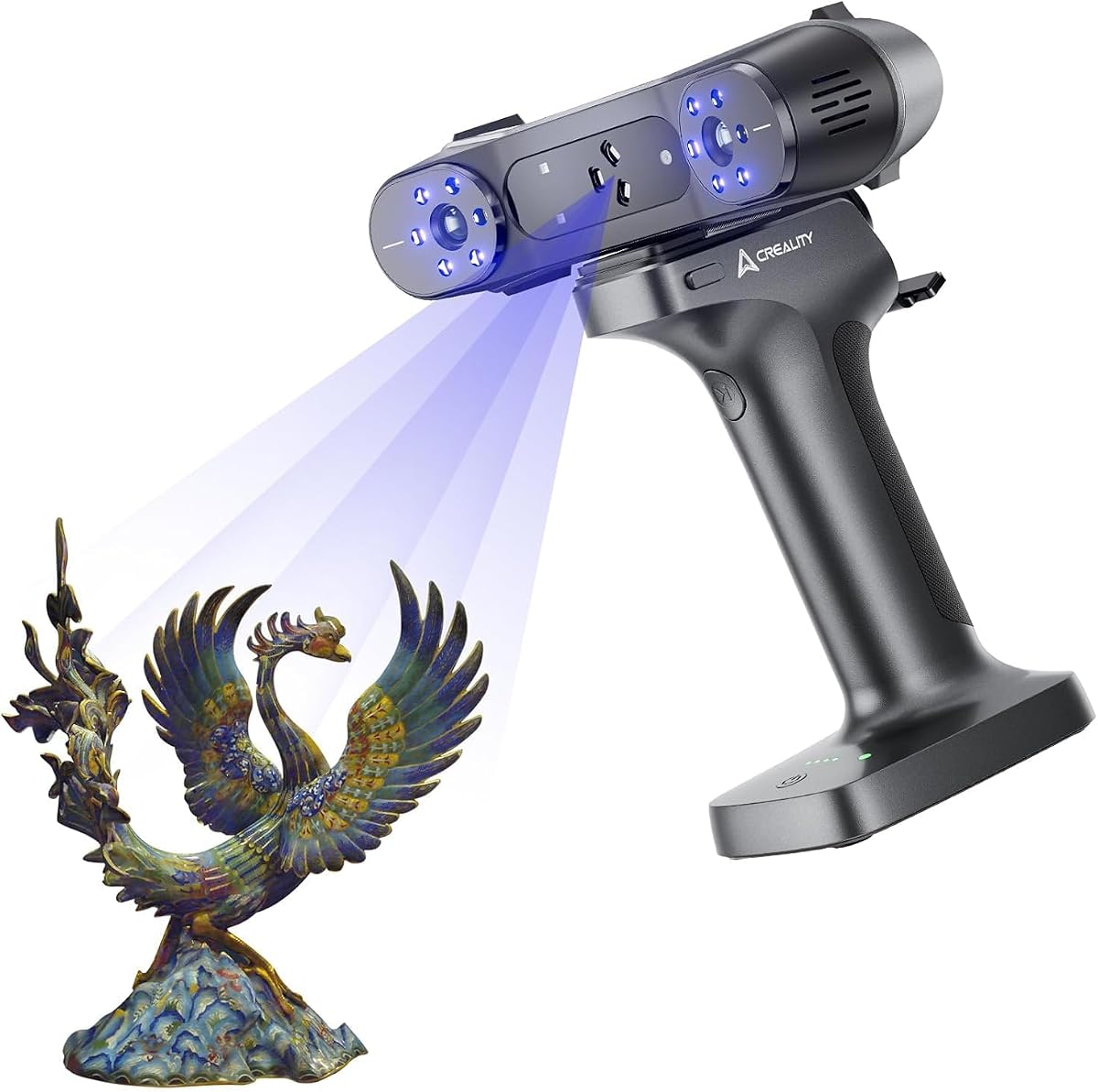
The EinScan Rigil is a premium device that integrates computing power directly into the scanner itself. This design allows for true wireless operation without relying on a PC for processing.
We may earn a commission when you buy through this link, at no additional cost to you.
It features a hybrid light source that combines Blue Laser with IR VCSEL technology. This ensures high accuracy and allows for scanning dark or reflective surfaces without using any markers or sprays.
The device includes a powerful internal CPU and a massive 1TB SSD for storing scans. This makes it self-contained, which is perfect for field work where laptops are not practical or available.
For engineers who need a portable solution that performs in sunlight, this is an excellent choice. The internal battery and robust construction support demanding outdoor environments.
With a 2.4GHz CPU and 32GB RAM, the scanner processes data on the go without needing a connected computer for immediate results.
The advanced algorithms and laser technology allow for reliable scanning even in bright outdoor conditions where other sensors might fail.
We may earn a commission when you buy through this link, at no additional cost to you.
The Creality Otter Lite Basic is an ideal entry-level option for hobbyists and small businesses starting in reverse engineering. It delivers professional-grade precision at a fraction of the cost of high-end units.
We may earn a commission when you buy through this link, at no additional cost to you.
It supports both close-range and long-range scanning modes. This flexibility allows you to capture fine details on small objects or scan larger items efficiently using the same device.
The scanner is extremely light at just 235g, making it easy to hold for extended periods. It also captures full-color textures, which adds realism to your 3D models.
If you are looking for a cost-effective way to begin digitizing parts, this model is a strong contender. It provides the necessary accuracy for many basic engineering and design tasks.
Switch between close-range for detailed small parts and long-range for larger objects, adapting to various project needs instantly.
The package includes everything needed to start, such as markers, a turntable, and calibration boards, saving you extra purchases.
We may earn a commission when you buy through this link, at no additional cost to you.
The Revopoint MetroX Pro is designed for industrial-grade high-precision scanning. It uses blue laser technology to capture every detail and dimension flawlessly.
We may earn a commission when you buy through this link, at no additional cost to you.
It offers single-frame precision of up to 0.01 mm which is crucial for quality inspection tasks. This level of detail ensures that your reverse engineering models match the original parts exactly.
The scanner includes a variety of modes to handle different surface types. You can use cross-line lasers for flat surfaces or full-field structured light for complex objects without markers.
For those needing a balance of speed and accuracy, this model is a top contender. It simplifies the workflow with automatic turntable scanning and real-time viewing options.
Blue lasers provide better performance on dark and shiny surfaces compared to traditional red lasers, reducing the need for spray.
Stream scans to a phone or tablet to detect data gaps and move freely without holding a laptop during the process.
We may earn a commission when you buy through this link, at no additional cost to you.
The Creality CR-Scan Raptor Pro is equipped to handle everything from tiny components to massive machinery parts. It uses 22 crossed blue lasers plus infrared light for comprehensive coverage.
We may earn a commission when you buy through this link, at no additional cost to you.
Its scanning speed is impressive, reaching up to 660,000 dots per second. This high frame rate helps in capturing complex geometry quickly without losing detail.
The device adapts to various environments with a temperature compensation algorithm. This ensures stability whether you are working in a cold warehouse or a hot shop floor.
If your projects involve scanning large vehicles or big molds, this scanner provides the reach and precision needed. It exports data to standard formats for easy integration into design tools.
Support for body and face scanning makes it versatile beyond just industrial parts, suitable for medical or creative applications too.
Blue laser technology allows scanning of black and metal objects directly, saving the step of applying powder sprays.
We may earn a commission when you buy through this link, at no additional cost to you.
The Revopoint INSPIRE 2 is specifically designed to handle outdoor environments where light conditions vary. It allows for reliable scanning in shaded or semi-bright conditions.
We may earn a commission when you buy through this link, at no additional cost to you.
Its lightweight design at 190g makes it easy to carry in a field bag. This portability is essential for engineers who travel to different sites for measurements.
The scanner uses infrared laser lines to capture details on reflective or dark surfaces without spray. This feature simplifies the preparation process for on-site tasks.
If you need a portable tool for heritage preservation or outdoor industrial inspection, this is a great fit. It balances performance and convenience effectively for mobile work.
The optical zoom allows you to focus on specific details on mixed-geometry surfaces, enhancing versatility for different object sizes.
A high-precision calibration board boosts point cloud accuracy by 75%, ensuring consistent data for professional workflows.
We may earn a commission when you buy through this link, at no additional cost to you.
The Revopoint MetroX Pro Standard is tailored for engineers who need flexibility in tracking complex geometries. It offers three distinct modes to suit different object types.
We may earn a commission when you buy through this link, at no additional cost to you.
Feature tracking works well for objects with rich surface details. Marker tracking is best for flat surfaces, while global marker mode enhances accuracy for complex shapes.
The scanner includes an HD RGB camera for capturing color-accurate scans. This adds realism to the digital model which is useful for visualization and presentation.
If you often work on parts that require specific tracking methods, this model adapts easily. It provides a reliable solution for industrial inspection and creative design.
Use the dual-axis turntable to automate scans of complex objects, reducing manual effort and ensuring consistent coverage.
See scans take shape on a mobile device so you can detect gaps quickly and move freely around the object.
We may earn a commission when you buy through this link, at no additional cost to you.
The Creality Raptor Pro Wireless delivers metrology grade accuracy which is essential for high-end engineering projects. It captures intricate details without needing spray powder.
We may earn a commission when you buy through this link, at no additional cost to you.
It combines 22 crossed blue lasers with infrared light to handle challenging materials. This setup allows for accurate measurement of modified engine parts or custom car bodies.
The device supports face and body scanning modes for medical or 3D printing use. It can scan a full body in just two minutes, showing its versatility beyond industrial parts.
For projects demanding precision and minimal preparation time, this scanner is highly effective. It integrates well with professional software for a smooth workflow.
The laser lines can withstand bright sunlight, allowing you to work outside without a lab environment.
The CrealityScan app offers step-by-step tutorials and advanced editing tools to simplify model refinement.
We may earn a commission when you buy through this link, at no additional cost to you.
The Creality Raptor X redefines portability with a wireless handle that transmits data seamlessly. It uses 34 cross laser lines for rapid and effortless capture of medium to large objects.
We may earn a commission when you buy through this link, at no additional cost to you.
With an accuracy of up to 0.02mm, it is ideal for engineering parts and molds. The one-shot 3D imaging technology ensures smooth handheld scanning without losing tracking.
The scanner includes a large capacity battery that can be charged to 80% in just 1.5 hours. This supports long sessions in the field without interruption.
If you need high speed and wireless freedom for scanning cars or large structures, this model excels. It is a powerful tool for professionals needing consistent accuracy.
Advanced algorithms transfer scans quickly over Wi-Fi 6, ensuring you do not lose detail during the wireless process.
Adopting one-shot 3D imaging makes handheld scanning smoother by reducing shake errors effectively.
We may earn a commission when you buy through this link, at no additional cost to you.
The Creality Raptor Pro is a high-precision tool designed for reverse engineering and detailed 3D modeling. It achieves metrology-grade accuracy suitable for industrial inspection.
We may earn a commission when you buy through this link, at no additional cost to you.
It combines blue laser lines with infrared structured light to handle objects ranging from 5mm to 4000mm. This versatility allows you to scan everything from molds to entire vehicles.
The software offers multi-project stitching and adjustable resolution for seamless 360-degree scans. This makes it easier to process and refine data after the initial capture.
For professionals needing a robust solution for artifact or automotive scanning, this is a strong option. It balances precision with a wide range of supported object sizes.
Upgraded dual laser mode with 22 cross lines and 7 parallel lines provides comprehensive coverage for large objects.
Speckle matching 3D imaging means you do not need markers for feature-rich workpieces, saving setup time.
We may earn a commission when you buy through this link, at no additional cost to you.
Selecting the right scanner requires evaluating several factors to ensure it meets your specific workflow needs.
Accuracy refers to how close the scanned data is to the real object, while precision is about the consistency of the scan. For reverse engineering, you need high accuracy to ensure parts fit correctly in assemblies. Look for single-frame precision of at least 0.02 mm or better for industrial applications.
Always prioritize high precision for tight tolerance parts.
Speed is crucial when scanning large objects or working on time-sensitive projects. A scanner with a high frames per second (FPS) rate will capture more data points per second, reducing the time spent on each scan. Look for speeds over 60 FPS for efficient workflows.
Higher frame rates mean faster data acquisition and less downtime.
Blue lasers are generally better at scanning dark or shiny surfaces compared to red lasers because they reflect less light. This reduces the need for applying spray powder on parts. If you work with automotive parts or polished metals, a blue laser scanner is a safer choice.
Blue laser technology is essential for scanning dark or reflective materials.
Wireless scanners offer greater freedom of movement, allowing you to walk around large objects without tripping over cables. However, they may require higher-end computing hardware to process data wirelessly. Wired scanners are often more stable but limit your range of motion.
Wireless offers mobility while wired offers stability and speed.
The software that comes with the scanner must be able to export files to your CAD tools. Check for support of common formats like STL, OBJ, PLY, and STEP. Some systems offer advanced editing features that can save time during the reverse engineering process.
Ensure the software exports to your CAD tools efficiently.
If you plan to use the scanner in the field, look for a lightweight design with a long-lasting battery. Some models include a battery grip for extended use. Consider how much you are willing to carry and how long you need to operate without a power outlet.
Lightweight scanners with batteries are essential for field work.
Different scanners handle different sizes. Some are optimized for small parts like jewelry or engine components, while others can handle car bodies or large machinery. Check the minimum and maximum scanning volumes to ensure the device fits your project scope.
Match the scanner size to your typical project volume.
Prices vary widely from entry-level to industrial models. While industrial units cost more, they offer better accuracy and support. Consider the total cost of ownership including software subscriptions and accessories. Balance your budget against the required precision for your work.
Balance cost with the required level of precision.
Before starting a scan, calibrate the device using the provided board to ensure accuracy. Place the object on a stable turntable or mount it securely to prevent movement during the process.
Clean the lens of the scanner regularly with a soft cloth to avoid smudges that can affect data quality. Avoid touching the laser sensors with your fingers to keep them free of oils.
Store the scanner in a dry, cool place inside its protective case when not in use. Keep cables organized and protected from sharp edges to prevent damage to the connections.
For most industrial applications, an accuracy of 0.02mm or better is recommended. This ensures that scanned parts will fit into existing assemblies without modification. High-end metrology scanners can achieve even tighter tolerances for critical components.
Yes, many modern scanners use blue lasers that can handle shiny or dark surfaces without the need for spray. This saves time and avoids leaving residues on delicate parts during inspection processes.
Yes, scanning software often requires a strong GPU and processor to handle large datasets. Most manufacturers recommend at least an i7 processor and dedicated graphics card for smooth performance.
Large objects can be scanned in sections and then stitched together. Ensure the scanner supports multi-project stitching in its software to merge different scans into a single model.
Some scanners are designed to work in outdoor conditions with built-in light compensation. Check the lux rating to ensure the device performs well in sunlight.
Most scanners support common formats like STL, OBJ, PLY, and STEP. Always verify compatibility with your specific CAD software before purchasing.
We found that the Revopoint MetroY Ultra leads the pack with its balance of speed and precision. The EinScan Rigil offers a premium all-in-one experience for those needing portability.
Consider your specific needs such as object size and budget when selecting a device. Entry-level models like the Otter Lite Basic are great for starting out without high costs.
Remember to check current pricing and availability before buying as deals change frequently. The right scanner can significantly streamline your engineering workflow.